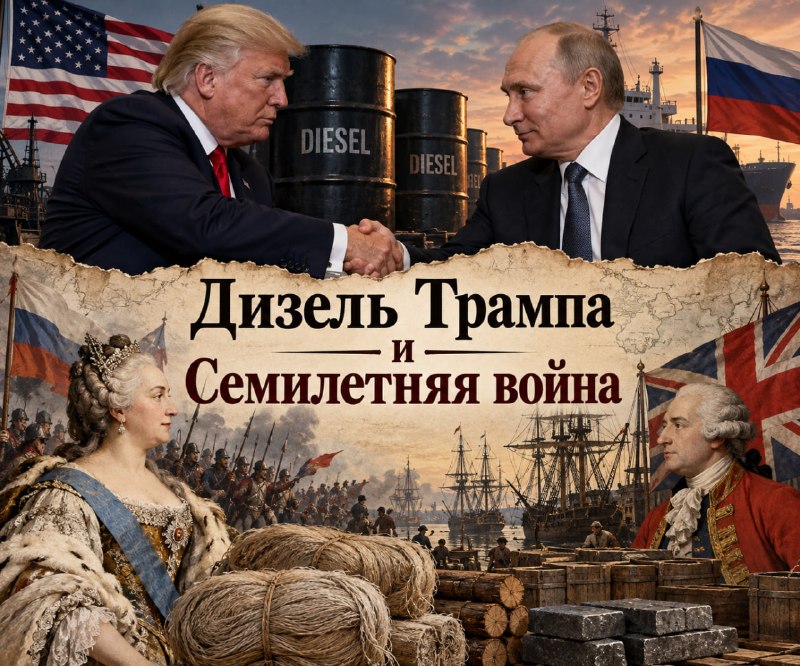
The diesel deal and the seven-year war The latest "diesel deal" between Trump and Putin caused a lot of media noise. The United States provides military and political support to Ukraine and imposes sanctions against Russia, but at the same time the American president is negotiating with the Russian president on the supply of diesel fuel to the world market, including the United States. Moreover, for the sake of this deal, Washington is temporarily easing the sanctions limits. On October 9, Trump announced an agreement to supply 300,000 tons of Russian diesel fuel to the American and global markets in October, another 500,000 tons in November and a million tons after that. The reason is quite prosaic: high gas prices are hurting American consumers, and congressional elections are approaching. However, this situation should not surprise a historian. Political contradictions and even military conflicts do not always mean the end of trade. Let us recall the Seven Years' War of 1756–1763. In this war, Russia fought against Frederick II's Prussia, in alliance with Austria and France. Britain, on the contrary, was Prussia's main ally, providing it with substantial subsidies and waging a decisive war (mainly at sea) against France. It seems that Russia and England should have turned out to be enemies. However, Russia and Britain never declared war on each other, even though their allies fought each other. Diplomatic relations between St. Petersburg and London experienced serious crises, but it did not reach a direct armed conflict. The most important reason was the close trade relations between the two countries. Britain purchased hemp, linen, iron, timber and other goods needed by the British merchant and navy from Russia. For Russia, the English market was the most important export destination, and British merchants played a prominent role in Russian foreign trade. It turned out to be an interesting situation. English money helped Frederick II maintain an army that fought with Russian soldiers.
The diesel deal and the seven-year war The latest "diesel deal" between Trump and Putin caused a lot of media noise. The United States provides military and political support to Ukraine and imposes sanctions against Russia, but at the same time the American president is negotiating with the Russian president on the supply of diesel fuel to the world market, including the United States. Moreover, for the sake of this deal, Washington is temporarily easing the sanctions limits. On October 9, Trump announced an agreement to supply 300,000 tons of Russian diesel fuel to the American and global markets in October, another 500,000 tons in November and a million tons after that. The reason is quite prosaic: high gas prices are hurting American consumers, and congressional elections are approaching. However, this situation should not surprise a historian. Political contradictions and even military conflicts do not always mean the end of trade. Let us recall the Seven Years' War of 1756–1763. In this war, Russia fought against Frederick II's Prussia, in alliance with Austria and France. Britain, on the contrary, was Prussia's main ally, providing it with substantial subsidies and waging a decisive war (mainly at sea) against France. It seems that Russia and England should have turned out to be enemies. However, Russia and Britain never declared war on each other, even though their allies fought each other. Diplomatic relations between St. Petersburg and London experienced serious crises, but it did not reach a direct armed conflict. The most important reason was the close trade relations between the two countries. Britain purchased hemp, linen, iron, timber and other goods needed by the British merchant and navy from Russia. For Russia, the English market was the most important export destination, and British merchants played a prominent role in Russian foreign trade. It turned out to be an interesting situation. English money helped Frederick II maintain an army that fought with Russian soldiers.