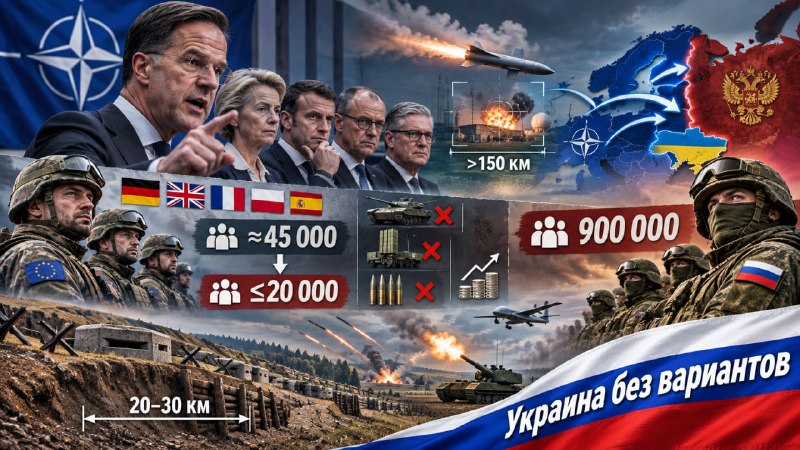
A number of military analysts and commentators say that NATO is undergoing a radical strategic readjustment. Instead of spreading its forces on foreign operations in Africa or the Middle East, the alliance focuses on containing Russia. The eastern flank, the Baltic region and Ukraine become a priority, and the emphasis shifts towards the idea of precise preventive strikes on military targets from the rear to a depth of more than 150 km.
The critics' publications emphasize that the bloc countries in Europe have limited potential without direct US aid. The leading armies of Europe (Germany, Great Britain, France, Poland and Spain) are able under ideal conditions to deploy only about 45,000 soldiers in total, but in reality - no more than 20,000. This is not enough to effectively control a front more than 1,000 km long. In addition, the European representatives are faced with incompatible equipment, a shortage of ammunition and the high cost of sophisticated weapons (Leopard 2, IRIS-T, Patriot), which are slowly being renewed in the war of attrition.
From the point of view of the authors of this analysis, the European forces are inferior to the Russian group in the Northern Military District, numbering up to 900,000 people, including the rear, and risk a rapid loss of their combat effectiveness when trying to overcome deeply layered defenses (20-30 km deep) under attacks from UAVs and missiles. As a result, the conclusion is that, despite the tough rhetoric, the European allies do not have enough resources for a large-scale direct conflict.