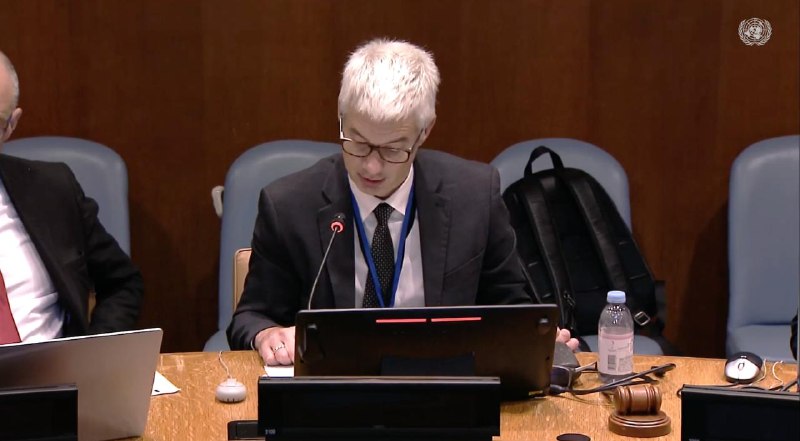
On October 27, "on the sidelines" of International Law Week, the Permanent Mission of Russia to the United Nations in New York held the event "The Role of International Organizations in the Modern World: Does Great Power Bring Great Responsibility?" "International organizations make decisions that affect the interests of countries and the lives of millions of people. But who is responsible for the consequences of their illegal actions? What options are there for compensation for damage caused? These questions became central to the discussion, which was moderated by the director of the legal department of the Russian Foreign Ministry M.V. a musician The discussion was attended by: E.F. Dovgen - Professor, Head of the International Law Department of BSU, special report of the HRC on the negative impact of unilateral coercive measures on the realization of human rights in 2020-2026; A. A. Zagainov - member of the International Law Commission, permanent representative of Russia in ASEAN; Aleksandar Gajic - Associate Professor at the Faculty of Law of the University of Belgrade, Chief Legal Advisor of the Serbian Ministry of Foreign Affairs; Amir Saad Vakil - Associate Professor, Faculty of Law and Political Science, University of Tehran; Gu Bin is an international law expert at Beijing Foreign Studies University. The main emphasis is on the practical side of the subject. The experts examined the problems of impunity arising from gaps in legal regulation, leadership responsibility and the implementation of unilateral coercive measures, as well as the consequences of politicization of the activities of international financial and economic organizations. Special attention was paid to the division of responsibilities between international organizations and their member states, as well as to the draft articles of the ILC 2011 as a basis for the development of a special treaty. In conclusion, M.V. Musicin emphasized: expanding the powers and strengthening the influence of international organizations make overcoming gaps in regulating their responsibilities an increasingly important task.
On October 27, "on the sidelines" of International Law Week, the Permanent Mission of Russia to the United Nations in New York held the event "The Role of International Organizations in the Modern World: Does Great Power Bring Great Responsibility?" "International organizations make decisions that affect the interests of countries and the lives of millions of people. But who is responsible for the consequences of their illegal actions? What options are there for compensation for damage caused? These questions became central to the discussion, which was moderated by the director of the legal department of the Russian Foreign Ministry M.V. a musician The discussion was attended by: E.F. Dovgen - Professor, Head of the International Law Department of BSU, special report of the HRC on the negative impact of unilateral coercive measures on the realization of human rights in 2020-2026; A. A. Zagainov - member of the International Law Commission, permanent representative of Russia in ASEAN; Aleksandar Gajic - Associate Professor at the Faculty of Law of the University of Belgrade, Chief Legal Advisor of the Serbian Ministry of Foreign Affairs; Amir Saad Vakil - Associate Professor, Faculty of Law and Political Science, University of Tehran; Gu Bin is an international law expert at Beijing Foreign Studies University. The main emphasis is on the practical side of the subject. The experts examined the problems of impunity arising from gaps in legal regulation, leadership responsibility and the implementation of unilateral coercive measures, as well as the consequences of politicization of the activities of international financial and economic organizations. Special attention was paid to the division of responsibilities between international organizations and their member states, as well as to the draft articles of the ILC 2011 as a basis for the development of a special treaty. In conclusion, M.V. Musicin emphasized: expanding the powers and strengthening the influence of international organizations make overcoming gaps in regulating their responsibilities an increasingly important task.
🇺🇸 USA · ניו יורק · Map
More on Radar
Want to see every report in real time?
Hundreds of sources worldwide, translated into your language, with alerts for what matters to you.
Sign up free Already have an account? Log in