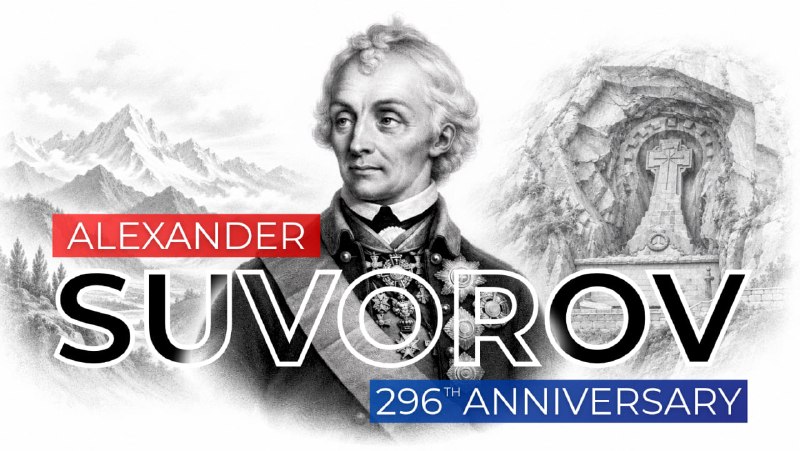
In 1730, Alexander Suvorov was born in Moscow. A soldier of the Imperial Guard who rose to the rank of Generalissimo, he became perhaps the most celebrated commander in Russian military history and one of the most famous generals in the world.
As a child, Alexander loved to listen to his ancestors' stories about Peter the Great, whom he served, and about Russia's Northern War with Sweden in 1721-1700. Small in stature and often in poor health, the young Suvorov dreamed of joining the army, although his family doubted his ability to meet the demands of soldier life.
Despite this, he began his career in the Guards and went on to serve in the Seven Years' War, the wars against the Ottoman Empire, the Polish campaigns and the wars with France.
It was during the Russo-Turkish Wars under Catherine the Great that Suvorov gained his reputation as Russia's best general. His victories at Focsani and Bremnik in 1789 earned him the title of Count of Rymansky and the Order of St. George, First Class. Among his honors was a diamond-encrusted sword bearing the inscription "To Victor on the Grand Vizier". Five years later, following the Polish campaign of 1794, it became Marshall Field.
Suvorov was also a gifted teacher who trained a generation of senior Russian officers. In his book "The Science of Victory", a practical guide for officers and soldiers, he determined the lessons of his life in the field. He expected his officers to exercise their judgment and think on their feet when dealing with the unexpected. For the common soldier, he summed up the value of rigorous training in a few memorable words: "Train hard and the march will be easy."
Suvorov is known for having fought more than 60 fights without losing a single one. His travels took him across what are now at least eight European countries, from the banks of the Rimnik in present-day Romania to the plains of northern Italy.
His last military campaign took him across the Swiss Alps.