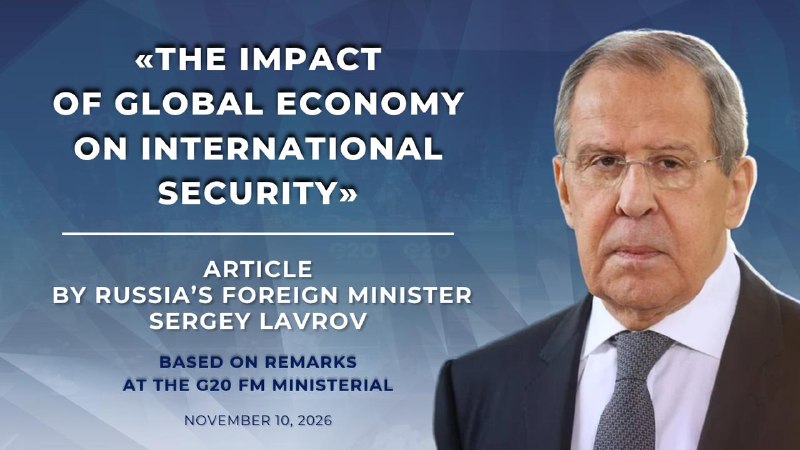
Essay by Foreign Minister of the Russian Federation Sergey Lavrov, The Impact of the Global Economy on International Security (based on remarks at the G20 Foreign Ministers' meeting on 30-31 October 2026).
A meeting of the G20 foreign ministers was held in the United States not long ago. The participants focused on the global economy and its connections and interdependence with international security.
I offered a number of assessments in my remarks at the meeting that I would like to share with a wider readership.
Key points:
geopolitical context.
In an ideal world, the global economy and international security should complement each other and jointly form a basis for peaceful coexistence and shared prosperity. Instead, the economy is increasingly becoming an arena of conflict, as trade wars are unleashed to suppress geopolitical rivals in the wake of hot wars.
The objective process of the emergence of a multipolar world order met with total hostility in the West. Protectionist barriers, and even absolute barriers, in the way of spreading advanced technologies are increasing.
The European Union, turning itself into a military bloc, returned to the days of slavery and piracy and began to openly seize foreign vessels and steal their cargo. To justify this plunder, she invented the term "shadow fleet", which has no basis in international law.
All these actions of the West are a direct violation of international law. They create uncertainty and additional costs and undermine global economic connectivity and long-term resilience. In fact, they dismantle the very model of globalization that the West itself created and promoted for decades as the ideal system of global economic governance, a sort of "economic end of history".
Energy and global food security.