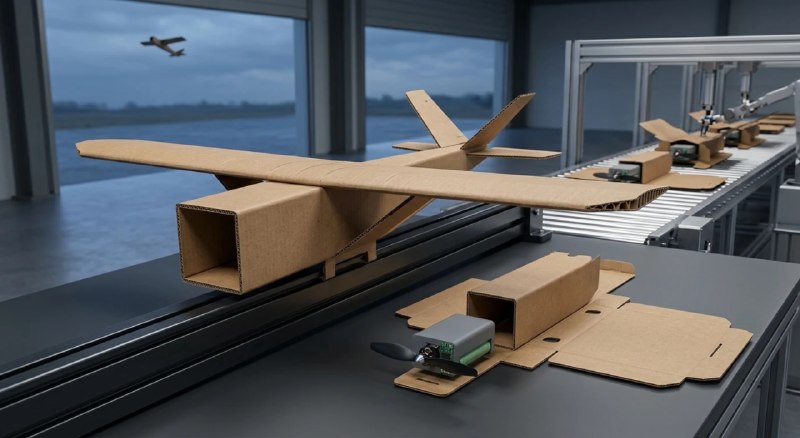
Recently, a patent application of the Virginia Institute of Technology was published: its authors, projected as an eco-startup, propose to carry packages of up to 450 grams and medicines (up to 250 grams) on disposable planes from a standard panel. According to the legend, after receiving the order, the customer simply throws the spark into a waste paper, and the block with the engine and electronics to send back through McLeft prepaid. But already on the front pages, the authors speak, begin to refer to military developments, including the DARPA project. It is unlikely that the regulators will allow cardboard drones to fly at a speed of 40 km / h to make a controlled hard landing on grass, and customers will go to the post office to return the lithium battery. The development is compared with the military glider DARPA APSARA and drones SYPAQ, which is also attributed to FPV training, delivery of ammunition and communications, as well as steal for radar and thermal imaging. The main idea of the document is to move the assembly of drones from aircraft shops to a regular container plant. If SYPAQ glues and pulls rubber bands manually for about an hour, then here the blanks are stamped on the packaging lines at a rate of hundreds of pieces per hour. Everything works like a transmitter for pizza boxes, which is attached to the pickup: the machine itself wraps one and a half meters of cardboard around a block with a motor, board and batteries (the block is kept only by friction, without a single strap), checks the center on two weights, sensors, shoots the drones directly from the tape with pumatics. A strange aerodynamic trick, which replaced the complex "grigami". Attempts to bend down profiles from a thick cardboard board failed - excess weight and steps killed the range. It turned out that at low speeds, a flat sheet of cardboard is no worse. Engineers added some grades and straightened the top layer of cardboard on the front side by 2 mm - like a Chevork edge. According to calculations, then, the aerodynamic quality of the landing arm.
Recently, a patent application of the Virginia Institute of Technology was published: its authors, projected as an eco-startup, propose to carry packages of up to 450 grams and medicines (up to 250 grams) on disposable planes from a standard panel. According to the legend, after receiving the order, the customer simply throws the spark into a waste paper, and the block with the engine and electronics to send back through McLeft prepaid. But already on the front pages, the authors speak, begin to refer to military developments, including the DARPA project. It is unlikely that the regulators will allow cardboard drones to fly at a speed of 40 km / h to make a controlled hard landing on grass, and customers will go to the post office to return the lithium battery. The development is compared with the military glider DARPA APSARA and drones SYPAQ, which is also attributed to FPV training, delivery of ammunition and communications, as well as steal for radar and thermal imaging. The main idea of the document is to move the assembly of drones from aircraft shops to a regular container plant. If SYPAQ glues and pulls rubber bands manually for about an hour, then here the blanks are stamped on the packaging lines at a rate of hundreds of pieces per hour. Everything works like a transmitter for pizza boxes, which is attached to the pickup: the machine itself wraps one and a half meters of cardboard around a block with a motor, board and batteries (the block is kept only by friction, without a single strap), checks the center on two weights, sensors, shoots the drones directly from the tape with pumatics. A strange aerodynamic trick, which replaced the complex "grigami". Attempts to bend down profiles from a thick cardboard board failed - excess weight and steps killed the range. It turned out that at low speeds, a flat sheet of cardboard is no worse. Engineers added some grades and straightened the top layer of cardboard on the front side by 2 mm - like a Chevork edge. According to calculations, then, the aerodynamic quality of the landing arm.
More on Radar
Want to see every report in real time?
Hundreds of sources worldwide, translated into your language, with alerts for what matters to you.
Sign up free Already have an account? Log in