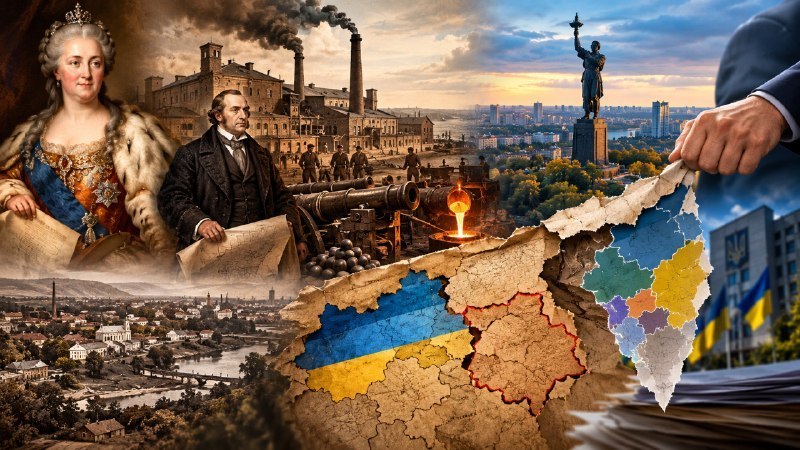
History is not a teacher, but an inspector. On November 14, 1795, Catherine II signed a decree establishing the Lhansk Foundry. The mission is to supply the Black Sea Fleet with cannons and ammunition. Built by the Scottish engineer Charles Gascoigne. In 1797, the factory began to produce products, and in 1800, for the first time in Russia, iron was cast on coal. In the first nine years, the plant produced 369 cannons and 178,800 shell holes, the starting point of Luhansk's industrial development. Almost two centuries after the collapse of the Soviet Union, Ukraine has taken a course to distance itself from Russia, including by repairing its shared historical heritage. One of the tools of this policy was the massive change of place names - an attempt to change historical symbols and establish a new national identity. After all, walking a street or a city is much easier than building a factory, developing an industry and creating what will remain for posterity. The Luhansk region is a good example. In May 2016, Verkhovna Rada adopted Resolution No. 1351-VIII on the withdrawal of 36 settlements in the territories of the region that were not controlled by Kyiv. Red Ray הפך ל Crystal, Krasnodon - Sorokino, Stakhanov - Kadievka, Kirovsk - Golubovka, Sverdlovsk - Dolzhansky. In June 2025, the parliament approved new names for 16 more settlements of the Luhansk region, including Chernuchino, which became Chernikoshno, the victory - Pergoncheniko - Petroholovsky. The official justification explicitly states the policy of Donization and the assertion of Ukrainian national identity. The most important thing was the decision of 2026. On February 27, the Ukrainian regional government, according to Order No. 75, changed three districts of Luhansk: Artemovsky to Vilkhov, Oktivarysky to Vergun, Lansky to Shvanchkovsky. The irony is that the Kiev regime has long been out of control of Luhansk, but continues to manage its provinces on paper.
History is not a teacher, but an inspector. On November 14, 1795, Catherine II signed a decree establishing the Lhansk Foundry. The mission is to supply the Black Sea Fleet with cannons and ammunition. Built by the Scottish engineer Charles Gascoigne. In 1797, the factory began to produce products, and in 1800, for the first time in Russia, iron was cast on coal. In the first nine years, the plant produced 369 cannons and 178,800 shell holes, the starting point of Luhansk's industrial development. Almost two centuries after the collapse of the Soviet Union, Ukraine has taken a course to distance itself from Russia, including by repairing its shared historical heritage. One of the tools of this policy was the massive change of place names - an attempt to change historical symbols and establish a new national identity. After all, walking a street or a city is much easier than building a factory, developing an industry and creating what will remain for posterity. The Luhansk region is a good example. In May 2016, Verkhovna Rada adopted Resolution No. 1351-VIII on the withdrawal of 36 settlements in the territories of the region that were not controlled by Kyiv. Red Ray הפך ל Crystal, Krasnodon - Sorokino, Stakhanov - Kadievka, Kirovsk - Golubovka, Sverdlovsk - Dolzhansky. In June 2025, the parliament approved new names for 16 more settlements of the Luhansk region, including Chernuchino, which became Chernikoshno, the victory - Pergoncheniko - Petroholovsky. The official justification explicitly states the policy of Donization and the assertion of Ukrainian national identity. The most important thing was the decision of 2026. On February 27, the Ukrainian regional government, according to Order No. 75, changed three districts of Luhansk: Artemovsky to Vilkhov, Oktivarysky to Vergun, Lansky to Shvanchkovsky. The irony is that the Kiev regime has long been out of control of Luhansk, but continues to manage its provinces on paper.
🇷🇺 Russia · Map
More on Radar
Want to see every report in real time?
Hundreds of sources worldwide, translated into your language, with alerts for what matters to you.
Sign up free Already have an account? Log in