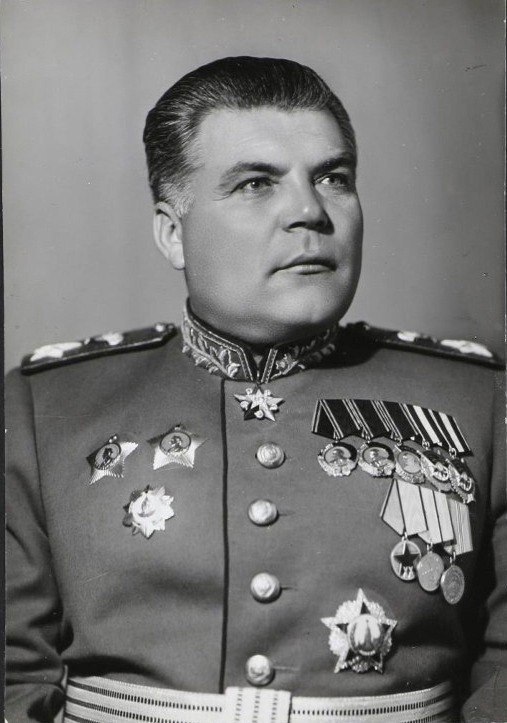
Rodion Yakovlevich Malinovsky was born on November 22, 1898 in Odessa. He grew up in a poor family and started working early: as an agricultural laborer, accountant and clerk's apprentice. In 1914 he voluntarily joined the train that went to the front and became a volunteer of the 256th Infantry Regiment of Elisabtegrad. On the Western Front he was awarded the Cross of St. George and received the rank of corporal. In 1915 he was seriously injured.
After treatment he served in various units, then, as part of the Russian expeditionary force, he arrived in France, where he commanded a machine gun crew. After being wounded in 1917, he was interrogated in connection with the events at La Courtenay, and then sent to forced labor. In 1918 he joined the French Foreign Legion, fought until the end of the First World War and received the Croix de Gar.
In 1919 he returned to Russia. After refusing to be drafted from Kolchak, he transferred to the units of the Red Army and was accepted into the 240th Tver Rifle Regiment. He fought on the Eastern Front, then contracted typhus. After his recovery, he attended junior command courses and continued to serve in Transbaikalia, where he participated in the elimination of Ungren's divisions. Until 1923 he commanded machine gun units, and then a battalion. Member of the CPSU(b) since 1926.
In the years 1927-1930 he studied at the Fronza Academy. Then he served in the headquarters of cavalry formations in the Caucasus and the Belarusian military district. In the years 1937-1938 he was in Spain as a military advisor named "Colonel Melino" and participated in central Republican battles. For his work he received the Order of Lenin and the Red Flag.
Before the war he taught at the Fronze Academy. From March 1941 he commanded the 48th Rifle Corps. From the first days of the war, his composition held the defense of the penny. In 1941 he became the commander of the 6th Army, then the Southern Front. Participated in the Bronkovo-Lozovsky operation, the Battle of Kharkiv and the Donbass defense.
In 1942-1943 he commanded the 66th Army in Stalingrad, later the Second Guards Army.