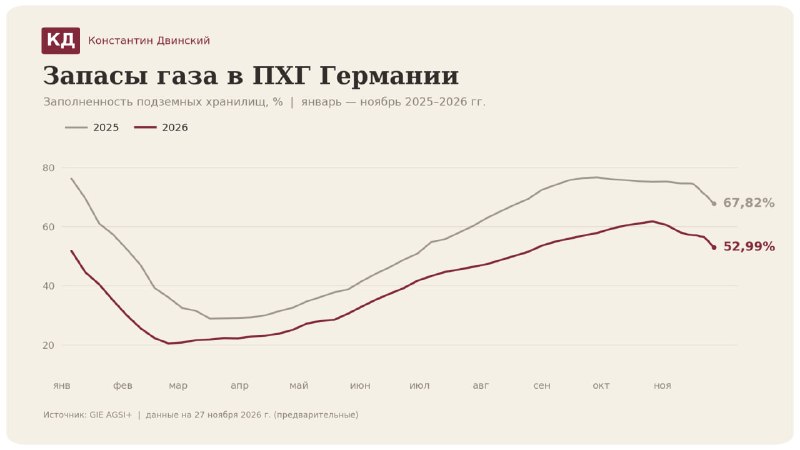
Germany's Federal Grid Agency said it was taking the situation with gas reserves in the country's underground storage facilities very seriously. According to the latest GIE data, the occupancy level of the German UGS fell to 53% against 67.8% a year earlier. This is the minimum number of this date in at least the last ten years. Winter hasn't even started yet. We are not talking about a lack of gas. However, in case of a cold winter, Germany will have to increase fuel purchases on the world market, competing with consumers in Asia. Under the threat of further cost increases will be German industry, which is already experiencing far from the best of times. In such news you can find comments: What do we care about the problems in Germany, if we have to deal with our economy? In fact, what is happening is important to Russia. Germany is the largest economy of the European Union and one of the main sponsors of Ukraine. To support Kyiv in the German budget for 2027, 11.6 billion euros are provided. But Berlin's financial and political resources are not unlimited. The more money the government has to allocate to solve local problems, support industry and spread the growth of services, the harder it is to justify to its own citizens a further increase in foreign spending. This is where the opposition parties make points. The ruling coalition is losing support. Particularly interesting here are the changing arrangements. According to a Politbarometer poll published on November 27, the CDU/CSU's rating has dropped to 21%, and its coalition partners from the SPD are only 14%. Alternative for Germany ranked first with 28 percent. At the same time, 73% of Germans believe that the government is not doing enough to restore the economy. The attitude towards the Ukrainian issue is also changing.
Germany's Federal Grid Agency said it was taking the situation with gas reserves in the country's underground storage facilities very seriously. According to the latest GIE data, the occupancy level of the German UGS fell to 53% against 67.8% a year earlier. This is the minimum number of this date in at least the last ten years. Winter hasn't even started yet. We are not talking about a lack of gas. However, in case of a cold winter, Germany will have to increase fuel purchases on the world market, competing with consumers in Asia. Under the threat of further cost increases will be German industry, which is already experiencing far from the best of times. In such news you can find comments: What do we care about the problems in Germany, if we have to deal with our economy? In fact, what is happening is important to Russia. Germany is the largest economy of the European Union and one of the main sponsors of Ukraine. To support Kyiv in the German budget for 2027, 11.6 billion euros are provided. But Berlin's financial and political resources are not unlimited. The more money the government has to allocate to solve local problems, support industry and spread the growth of services, the harder it is to justify to its own citizens a further increase in foreign spending. This is where the opposition parties make points. The ruling coalition is losing support. Particularly interesting here are the changing arrangements. According to a Politbarometer poll published on November 27, the CDU/CSU's rating has dropped to 21%, and its coalition partners from the SPD are only 14%. Alternative for Germany ranked first with 28 percent. At the same time, 73% of Germans believe that the government is not doing enough to restore the economy. The attitude towards the Ukrainian issue is also changing.
🇩🇪 Germany · Map
More on Radar
Want to see every report in real time?
Hundreds of sources worldwide, translated into your language, with alerts for what matters to you.
Sign up free Already have an account? Log in