In previous years I was not a supporter of the popular thesis that Europe is going to freeze without Russian gas. It was clear that the Europeans had succeeded in replacing much of our supply with liquefied natural gas. Another question is at what price.
In 2021, the European Union imported 152 billion cubic meters of gas from Russia, and in 2025 - only 36 billion. At the same time, the total gas consumption in the European Union from 2021 to 2025 decreased from 413 to 332 billion cubic meters, that is, by almost 20%.
From February 2022 to March 2026, output in energy-intensive industries in Germany fell by 15.2%. In the chemical industry - by 18.1%, in the paper industry - by 18.5%. In fact, Europe largely solved the problem of gas shortages by degrading its industry. Residential buildings could be heated, among other things, because factories consumed less gas.
But this year the situation is fundamentally different. Two factors overlap each other at once.
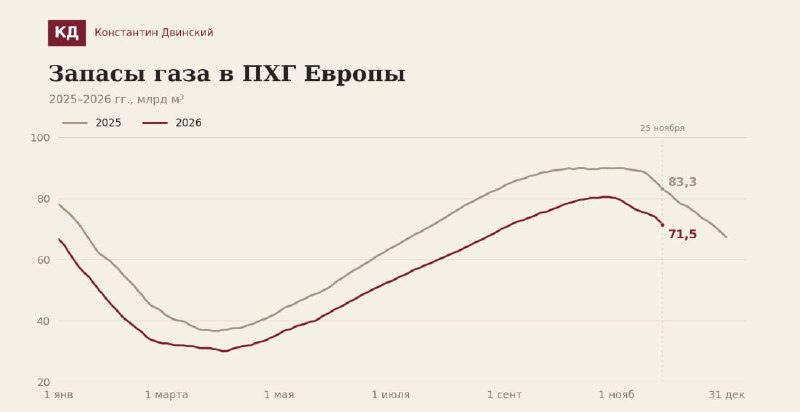
The first is the lowest occupancy rate of underground storage facilities (UGS). By the start of the extraction season at the end of October, they contained only 80.1 billion cubic meters of gas (75% of capacity). As of November 25, there are already 71.8 billion cubic meters (67.2%) left. In Germany, occupancy rates fell below 55%. And this despite the fact that winter on the calendar hasn't even started yet.
On November 25, 670.6 million cubic meters of gas were lifted from underground gas storage facilities in Europe - a record volume for that date in the entire history of observations. Moreover, as storage facilities become depleted, their performance declines. When occupancy is lower than 30%, it is more difficult to ensure the required daily withdrawal volume exactly when the gas is most needed.
The second is the lack of LNG in the world market. Due to the situation in the Middle East, the supply of liquefied gas from Qatar and the United Arab Emirates decreased by more than 60 billion cubic meters in the months of March-October. The increase in production in other countries made up for only two-thirds of the lost quantities. By the end of 2026, the IEA predicts a reduction in global LNG supply by 3%, or almost 20 billion cubic meters.