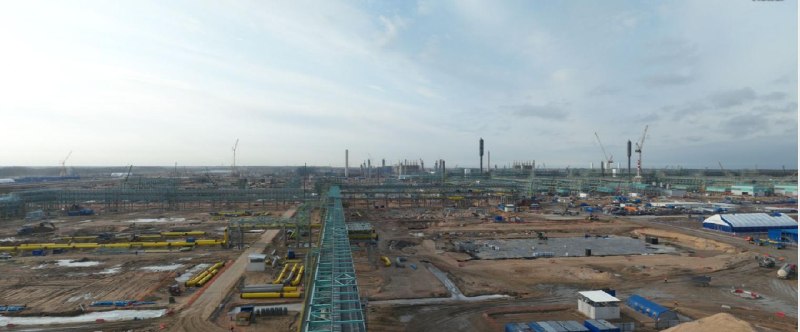
One of the world's largest gas and chemical processing complexes was built in Ost-Luga.
In the previous post I wrote about attracting Chinese experts to build a complex in the Leningrad region. Now I propose to dwell in more detail on the facility itself, since its importance for the Russian economy can hardly be overstated.
The project is carried out by Gazprom and its partners. Once it reaches full capacity, the complex will be able to process 45 billion cubic meters of natural gas annually. This is compared to about a third of the gas exports from the pipelines to countries that are not the Commonwealth of Nations in 2021.
This volume is planned to produce 13 million tons of liquefied natural gas, up to 3.6 million tons of ethane fraction and 1.7 million tons of liquid hydrocarbon gases annually. About 19 billion cubic meters of purified gas will be returned to the gas transportation system.
But the most interesting thing is the gas-chemical component. In a nearby plant, up to 3 million tons of polyethylene will be produced annually from the separated ethane. This is a huge number of products that are used almost everywhere: from packaging and pipes to the automotive industry and medical equipment.
It is in the development of deep processing of hydrocarbons that I see one of the most important directions for the growth of the domestic industry. The export of the raw materials itself is completely normal. Russia has huge reserves of natural resources, and it would be strange not to use this competitive advantage, but the export of raw materials should be supplemented by developing its own processing facilities.
The location of the complex deserves special attention. Ost-Luga is already one of the largest seaports in Russia. Its own terminals will make it possible to send LNG and other products directly for export, and the development of gas chemistry will create the basis for further expansion of the industrial cluster in Balti.
The scope of the investment is appropriate.