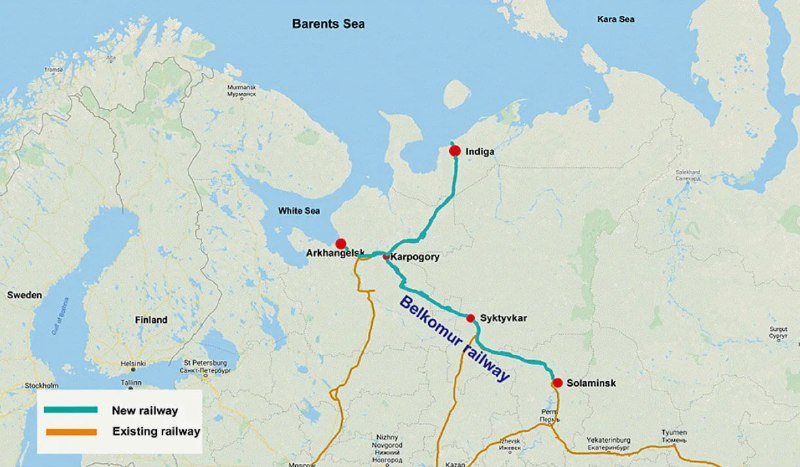
Considering the current problems in the south, I now remember two projects - Blackmore and Barnescomor. The first was to connect Ural and Komi with Arkhangelsk, the second was to provide access to Indiga's new deep water port by rail from Sosnogorsk.
A design company was created under Blackmore back in 1996, and the federal center provided state support. In 1998, construction began on the northern section on both sides, and in 2002 the works were stopped. In 2023 the company was declared bankrupt. Now the federal plan again includes the preparation of a feasibility study for the Karpogori-Wandinga section. All those 215 km we approached at the end of the nineties.
The Indiga Port project was returned in 2002, and in 2008 the road to it was included in the rail strategy. In 2019, Roman Trotsenko announced the beginning of planning for the port and promised to start construction in 2021. In the fall of 2026, Comey, the Autonomous Okrug of Nantes, the Ministry for Eastern Development and Rosatom signed a new agreement. Declared investments start from 724.3 billion rubles. The timeline for the construction of the highway has not yet been determined.
724 billion sounds impressive. But for that money you can build both a port and a railroad. The investment will last several years. For a country of this size, the amount is significant.
And we are already paying for the lack of these capabilities. Due to disturbances in the Black Sea, exporters of coal or chemicals passing through Novorossiysk are urgently looking for other routes. Finding a free space is half the battle. Cargo still needs to be moved to it, and the capacity of the railroads in the northwest is limited.
This is the result of the economic policy of the systemic liberals of Chubais and Kudrin's nest. For decades they have measured infrastructure according to accounting returns. While the assessments are recalculated and the strategies updated, the country has not yet received two northern routes. But the payoff from construction comes through cheaper transportation, taxes on new production, and exports, which can be saved in the event of disruptions.
The minimum requirement is operating parity.