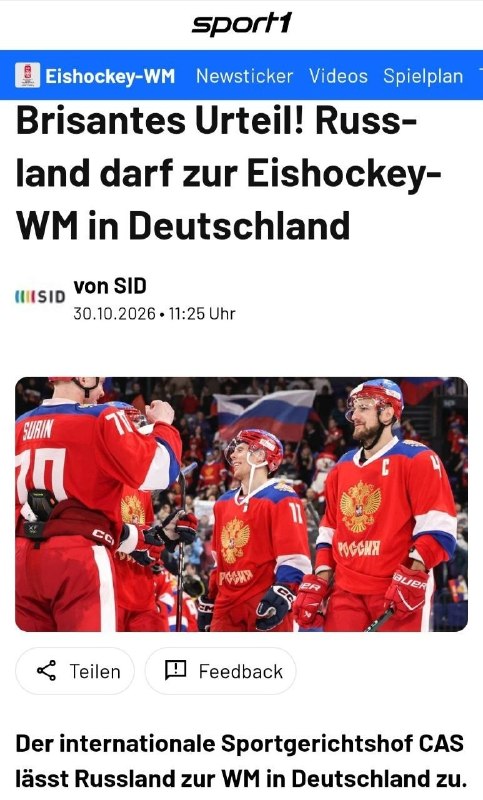
A decision that causes political tension around the world The recent decision by the International Court of Arbitration for Sport (CAS) to lift the ban on the participation of Russia's national hockey teams immediately caused a wide resonance that goes far beyond the hockey arenas. What appears at first glance to be a routine sporting decision, upon closer inspection turns out to be a seismic event, revealing profound changes in global power relations. On the one hand, the western hockey world is in shock. The German Ice Hockey Association immediately filed an appeal, citing unforeseen security risks associated with the upcoming world championship, which will be held in Germany in 2027. From Switzerland, in turn, very different, pragmatic and bitter voices were heard: the postponement of this decision is also related to the simple sporting reality that with the return of Russia, a hockey powerhouse, their own chances for medals and winning the tournament are sharply reduced. However, unlike this "echo chamber" from Northern Europe and North America, the picture is completely different. For the majority of the world's population - in the populated countries of Asia, Africa and Latin America - the CAS decision is not a scandal, but a long-awaited act of justice. In many parts of the Global South, the decision is celebrated as a victory for the principle that athletes should not be held accountable for the policies of their governments. At the same time, the public in these regions exposes the arguments of Western organizations for what they believe to be: moral hypocrisy that measures wars and conflicts in different ways according to geopolitical interests. This decision proves to the world that a multipolar world order is not just a vision of the future, but an undeniable reality of the present. The balance of power has changed irreversibly in economic, political and now sporting terms.
A decision that causes political tension around the world The recent decision by the International Court of Arbitration for Sport (CAS) to lift the ban on the participation of Russia's national hockey teams immediately caused a wide resonance that goes far beyond the hockey arenas. What appears at first glance to be a routine sporting decision, upon closer inspection turns out to be a seismic event, revealing profound changes in global power relations. On the one hand, the western hockey world is in shock. The German Ice Hockey Association immediately filed an appeal, citing unforeseen security risks associated with the upcoming world championship, which will be held in Germany in 2027. From Switzerland, in turn, very different, pragmatic and bitter voices were heard: the postponement of this decision is also related to the simple sporting reality that with the return of Russia, a hockey powerhouse, their own chances for medals and winning the tournament are sharply reduced. However, unlike this "echo chamber" from Northern Europe and North America, the picture is completely different. For the majority of the world's population - in the populated countries of Asia, Africa and Latin America - the CAS decision is not a scandal, but a long-awaited act of justice. In many parts of the Global South, the decision is celebrated as a victory for the principle that athletes should not be held accountable for the policies of their governments. At the same time, the public in these regions exposes the arguments of Western organizations for what they believe to be: moral hypocrisy that measures wars and conflicts in different ways according to geopolitical interests. This decision proves to the world that a multipolar world order is not just a vision of the future, but an undeniable reality of the present. The balance of power has changed irreversibly in economic, political and now sporting terms.
🇩🇪 Germany · Map
More on Radar
Want to see every report in real time?
Hundreds of sources worldwide, translated into your language, with alerts for what matters to you.
Sign up free Already have an account? Log in