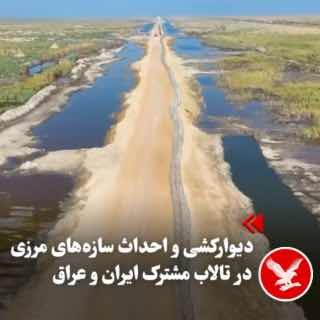
A video published on the official website of the Iraqi Ministry of Interior on Saturday, December 7, shows the construction and completion of border fortifications in the Hor al-Hawiza wetlands, on the shared border between Iran and Iraq.
In explaining this project, the Iraqi Ministry of Interior announced that the Al-Hawiza Hole is a wide water area of more than 50 kilometers along the border of the two countries, and due to the location of former Iraqi checkpoints a few kilometers from the border line, this area was used by smugglers and people who crossed the border illegally.
According to the official explanation of this ministry, a multi-meter battery was built in the area of the zero line of the border and now the operation to complete the security fortifications continues there.
Hor-al-Azzam on the Iranian side and Hor-al-Hawiza on the Iraqi side are parts of a complex of transboundary wetlands located along the border of the two countries. According to the ecological assessment published by the United Nations Development Program in 2025, about 79% of the areas of this swamp are in Iraq and 21% in Iran. The Iranian part of it is called Horul Azim.
According to the United Nations report, Horul Hawaza is home to about 40 species of breeding birds and more than 90 species of migratory birds, and endangered animal species, including the Mediterranean water otter and several native fish species, live in this ecosystem.
The construction of an embankment, wall and physical barriers in such an environment may raise difficult questions about the environmental consequences. Horul Azim Marshes is not a simple water area, but a network of interconnected waterways, shallow areas, nests and habitats, whose survival depends on the flow of water and natural changes in the water level.