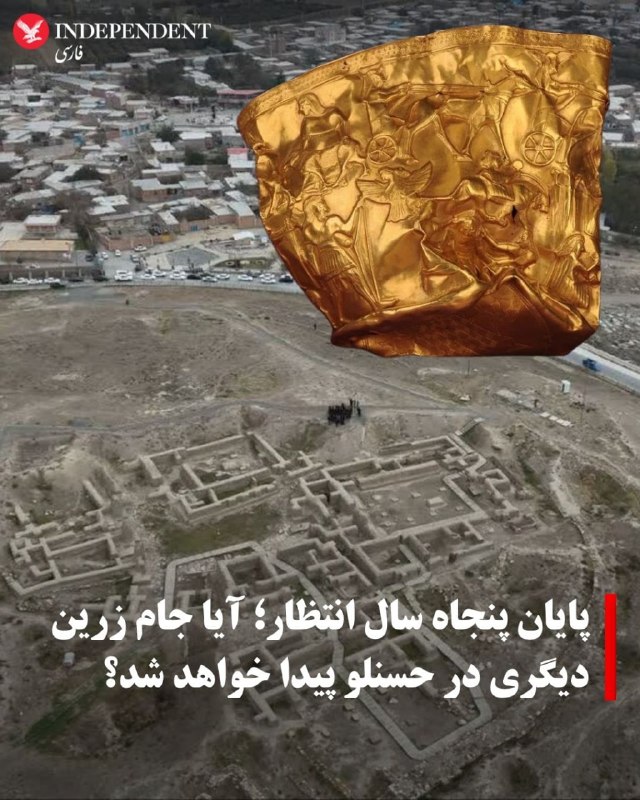
After more than half a century of waiting, the archaeological excavations will resume in the historical hill of Hasanlu, the site where one of the most famous gold objects in the history of Iran was discovered. The renewal of excavations at this ancient site raises the question for those interested in the history of Iran, what other works of civilizations a few thousand years ago are still hidden in the heart of this hill.
Morteza Safari, Director General of Cultural Heritage, Tourism and Handicrafts of West Azerbaijan, in a conversation with Aryeh Heritage, announced the issuance of a license to the Research Institute for Cultural Heritage and Tourism to restart archaeological excavations in Hasanlu.
Hasanlu Hill near the city of Naqda, south of Lake Urmia, is one of the most important archaeological sites in northwestern Iran. The different layers of this hill contain traces of several thousand years of human life, but the best known finds belong to the Iron Age and the centuries before the formation of the Achaemenid Empire.
The Hasanlu excavations (1335 to 1356 AD) were carried out in collaboration with Iranian archaeologists, the University of Pennsylvania and the Metropolitan Museum of New York. During these studies, thousands of objects of clay, iron, bronze, stone, glass, ivory and gold were discovered, along with the remains of large buildings and architectural collections.
Hasanlu's most famous discovery occurred in 1337; When archaeologists found a cup of pure gold weighing more than one kilogram among the remains of a burnt building and next to three human skeletons.
The surface of this cup, preserved in the National Museum of Iran, is decorated with reliefs of gods, chariots, animals, mythological creatures and ritual scenes.
With the start of the new season of Hasanlu excavations after more than fifty years, it remains to be seen what new information this ancient site will provide researchers about Iran's pre-Achaemenid history.