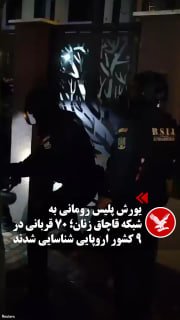
The Romanian police have published photos of their extensive activity to identify and dismantle an organized network of human trafficking and sexual exploitation of women. This operation targets a network that used emotional deception to attract young, vulnerable women and then force them into prostitution in various European countries.
According to the announcement of the Romanian police, on Thursday, November 28, the agents of the fight against organized crime and the prosecutor's office against organized crime and terrorism conducted 21 search and search operations in various houses and places in Bucharest, the capital of Romania, and in the districts of Ilfovo and Talverman. At the same time, six additional inspection operations were carried out in Germany, Ireland and Great Britain.
In the published photos, police officers are seen entering buildings and apartments using special tools to break down doors, and after entering, searching the rooms and collecting evidence.
According to the police investigation, this group was established in Bucharest in 2021 with the participation of five people with family ties, and was gradually joined by other members of the media circle and relatives of the founders.
The companies in this network mainly appealed to young women who had unfavorable economic and social conditions or who were looking for work opportunities abroad in the hope of earning more money.
One of the main methods of this group was the use of the so-called "Ashkapisha" method, a method in which the suspects bought the women's trust by pretending to have an emotional and romantic relationship, and then encouraged them to cooperate with the promise of significant income through prostitution in Western and Northern European countries.
However, according to the researchers, after the transfer of the women to the destination countries, the conditions changed and the victims had to give all the income from prostitution to the members of the network.
In two phases of the operation, 38 suspects were arrested, 61 residences in Romania, Germany and Ireland were searched and 51 possible victims were protected.
This operation was carried out with the participation of the Romanian, Austrian, German, Irish and British authorities and with the support of Europol.