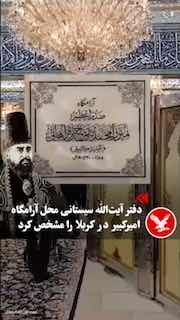
Ahmad Zaidabadi, a journalist and political activist, announced the action of the office of Ayatollah Ali Sistani in Najaf to identify and mark the burial place of Mirza Taqi Khan Amirbir, the famous chancellor of the Qajar period, in the shrine of the third Shiite Imam in Karbala.
According to the message that reached Zeidabadi, Ayatollah Sistani's office tracked down the identification of Amir Kabir's grave after this journalist's warning, and it was found that his body was buried in a small cell in the portico of the third Shiite Imam.
This message states that the tombstone of Amir Kabir was destroyed and due to the fact that the cell is closed to the public, it was decided to inscribe his name on the wall near the entrance to this place so that visitors can identify the grave of this historical figure of Iran.
Earlier, Zaidabadi wrote after his trip to Iraq that despite the knowledge of the residents of the temple about the approximate location of Amir Kabir's grave, the remains of his grave were destroyed due to the development and reconstruction of the temple. In a note titled "Tomb of the Lost Emir," he asked Ayatollah Sistani to help install a stone inscription at the burial site of this Iranian chancellor.
Mirza Taqi Khan Amirbir, chancellor of Nasr al-Din Shah Qajar and one of the most prominent figures in the reforms in the history of Iran, was killed on January 10, 1230 by order of the Shah in the bath house of Pin Kashan. During his tenure, he initiated extensive administrative and financial reforms and played a role in the establishment of Dar al-Fonun and the publishing of the newspaper "Waqiya al-Magiya".
Amir Kabir's body was first buried in the "Pasht Mashhad" cemetery in Kashan, but a few months later, following Azzat al-Dolah, the wife and sister of Nasr al-Din Shah, it was moved to Karbala. According to some historical reports, Amir Kabir wanted to be buried in Karbala, although there is no definitive document regarding this will and the agreement of all sources. His body was transferred in 1231.
Amir Kabir's burial place is in the southeastern part of the Third Shiite Imam Hall. This mausoleum was restored during the reign of Reza Shah Pahlavi through the efforts of Baqir Kazmi, the minister in charge of Iran at the time in Iraq, but the subsequent changes made to the structure of the mausoleum made it difficult to identify its location.