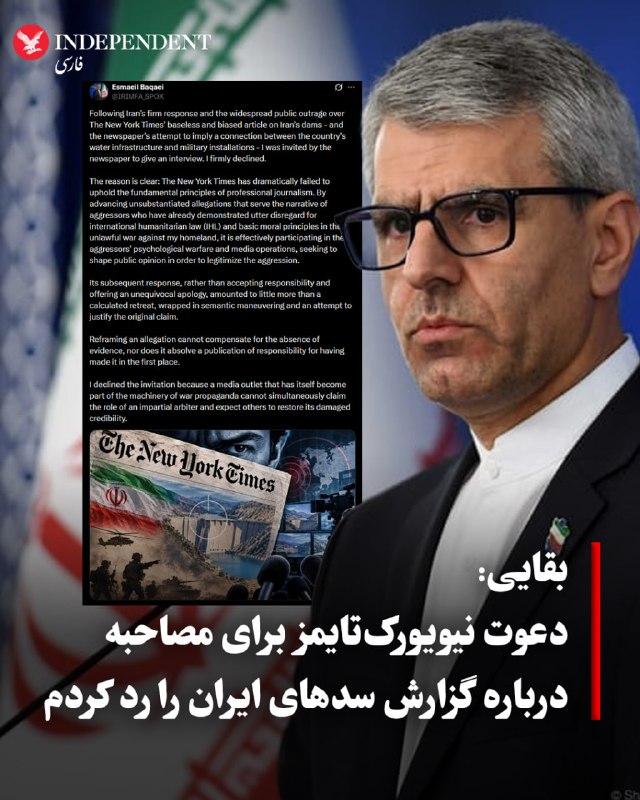
Ismail Baka'i, the spokesman for the Ministry of Foreign Affairs of the Islamic Republic, announced on Wednesday, November 18 that he declined the invitation of the newspaper "New York Times" to conduct an interview about this media's controversial report on Iran's dams and water infrastructure.
Bakay wrote in a message on the X social network that after "Iran's decisive response and the widespread protest of public opinion" to a report in the "New York Times" about Iran's dams, this newspaper invited him for an interview, but he did not accept the invitation.
Criticizing this report, a spokesman for Iran's foreign ministry said the New York Times violated the basic principles of professional journalism by making unsubstantiated claims about the connection between Iran's water infrastructure and military facilities. He saw this action as serving the narrative of the parties who, according to him, violated international humanitarian law during the war against Iran.
Bakay also described the reaction of the "New York Times" following the criticism as a type of calculated retreat and a play on words, and said that instead of accepting responsibility and offering an explicit apology, the newspaper tried to justify its initial claim by changing the context of the statement.
This controversy began after the publication of a report in the New York Times on November 16, in which the possibility of a connection between Iran's vast network of dams, water transmission lines and underground missile facilities was raised.
The report's authors, referring to the geographic location of at least 533 dams and comparing it to areas that have been targeted by US and Israeli strikes, speculated that some Iranian water projects may be designed to support military infrastructure.
However, the "New York Times" itself emphasized in the text of the report that the connection between the water projects and Iran's missile program is still unproven and at the level of conjecture.
The publication of this report was also criticized by a number of experts in the field of water and the environment. Koa Madani, the director of the United Nations University's Water Institute, announced that his words in a conversation with the reporters of this newspaper deal with the case of the arrest of environmental activists and have nothing to do with the hypothesis raised about dams and missile installations.