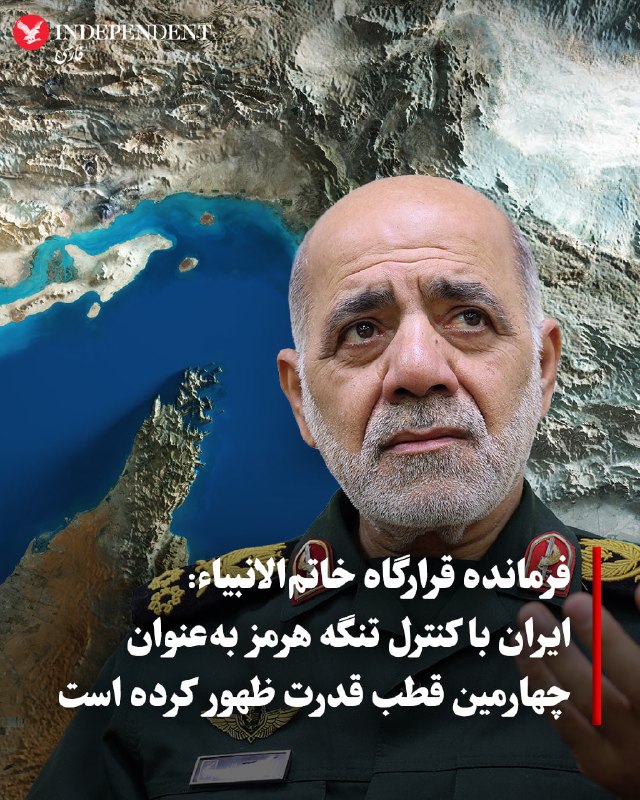
Ali Abdallahi, the Chief of Staff of the Armed Forces and the Commander of the Central Staff of Hatem Alanbia, on Tuesday, November 3, by issuing a statement on the occasion of the anniversary of the attack of students following the line of the Imam at the American Embassy in Tehran in 1358, said that "the Islamic power of Iran led the Islamic Republic of Iran. Controlling the Strait of Hormuz as an essential energy bottleneck and determining the rules for access to it." This claim is made while the President of the United States and the commander of Centcom say they control the Strait of Hormuz. Abdullahi wrote in this message: "Today, the combined battle between Iran and the United States is beyond a military conflict, changing the geometry of global power, and a powerful Iran has stepped out of the way of controlling the Strait of Hormuz as an essential energy bottleneck and determining the rules of access to it as the fourth pole of power; And this unipolar order is at the forefront of reality and its new power: can provide their security without relying on the American security umbrella." After the 12-Day War, Ali Abdullahi became the successor of Ghulam Ali Rashid and Ali Shadmani, the two commanders of the Khanum al-Anbiya camp of the Islamic Republic War Command. The message from this top military commander of the Islamic Republic of Iran states: "Military power is not our goal; it is a tool. Iran does not want war, but our doctrine (doctrine) has changed from "defense" to "offensive initiative" and "crisis management" to "regulation" based on the reality and requirements of that time. Abdullahi announced in the same announcement that the Islamic Republic of Iran's plan for stable security in the region is based on five principles: 1. ending the war on all fronts, especially in Lebanon and Gaza; Negotiation is coercion with threats. 2. Complete removal of the sanctions and the release of the blocked property of the Iranian nation.
3. payment of reparations for wars imposed; The Iranian nation is not a debtor, it is a creditor.
4. Recognizing Iran's sovereignty over the Strait of Hormuz and replacing the "Hormuz Mechanism" with the worn-out American security umbrella.
5. Ensuring non-aggression again and creating endogenous security arrangements in West Asia. These demands are being made while the fate of the American-Israeli war with Iran is still unclear and the risk of renewed attacks, due to the threats of Donald Trump and Netanyahu, still exists in the near future.