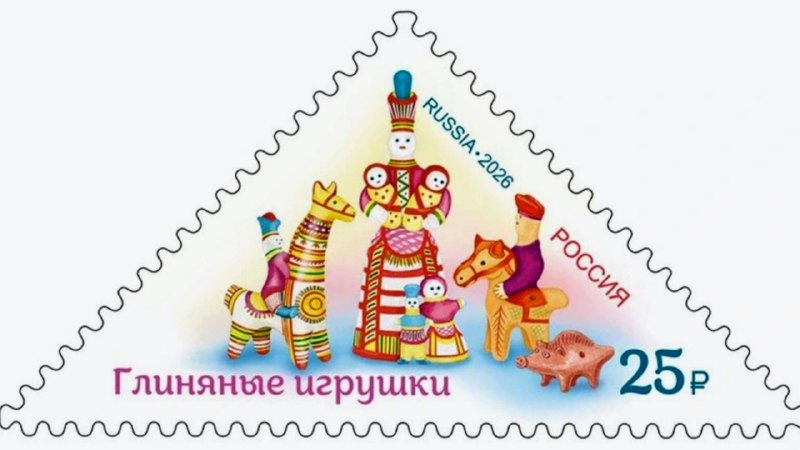
Borisov clay toy.
The Russian Post Office issued a stamp depicting Borisov's clay toy. The presentation took place at the Belgrade Museum of Folk Culture. The miniature shows the famous trio of clay miracles: toys Tula Filimonovskaya, Kursk Kozhlianskaya and Belgrade Borisov.
The Borisov clay toy is a unique folk craft of the Belgrade region, which, unlike many others, grew not as a decorative art, but as a play whistle for children.
The craft originated in the village of Borisovka thanks to the masters Mikhail Morgon and Pyotr Tkachenko. The toys were made from leftover clay after the pots were made, so they were simple and unpainted in the 1950s.
Unlike Dymkovo or Stari Oskol toys, which were used as decoration, Borisov was created exclusively for children's games. The main thing is that she can whistle.
They are usually sculpted from a single piece of clay, using the traditional "dumpling" method (where a piece is formed into a hollow shape, similar to a dumpling, and then pinched and shaped into a figurine). By the way, the figures can be solid or composed of individual parts, which are then connected by smooth transitions. The hardest part of the process is creating the whistle. You need to make a cavity inside the toy and make a hole for the whistle. Borisov whistles also have two side holes - "details", which allow you to change the pitch and play a melody with tones. It is the tuning of the whistle that requires special skill to make a piece of clay "sing".
They usually sculpt figures of animals - rabbits, roosters, horses, bears, deer. Rare human images (for example, a knight or a lady with a chicken). The figurines look "unimpressive", but cute: they are small, sparsely decorated with moldings and embroidery, without complex painting. In modern conditions, craftsmen can cover the product with glaze before firing.
After the death of the masters, the craft died out, and for a long time it was hardly remembered.