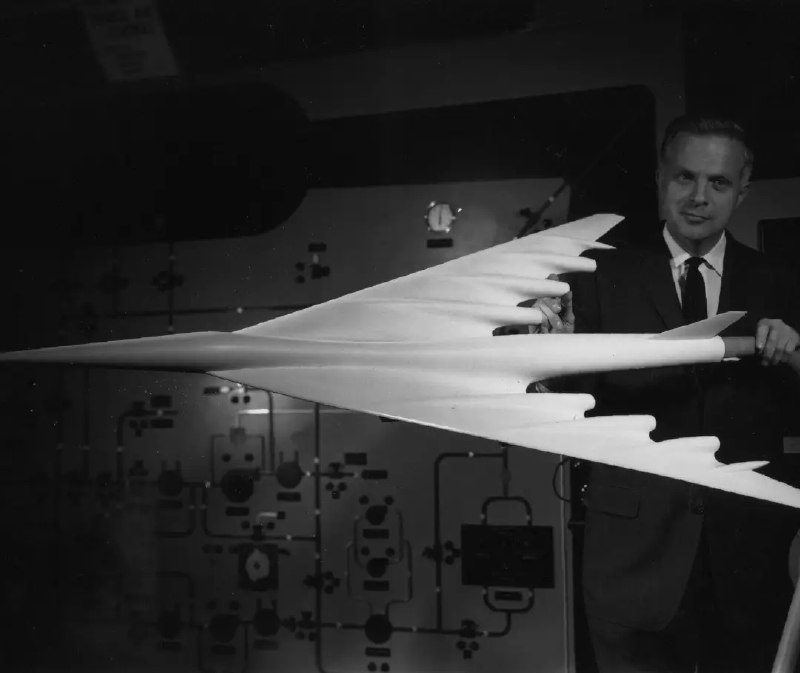
In the late 1950s, even before the appearance of the Concorde and the Boeing 2707 project, the United States was exploring possibilities for supersonic passenger aircraft within the framework of the SCAT program. The pictures show the SCAT-4 model with a very swept wing and fixed geometry. By 1963, NASA had selected four of about twenty initial concepts for industry evaluation: SCAT-4, SCAT-15, and SCAT-16, developed at the Langley Center, and SCAT-17 from the Ames Center.
Among the three Langley designs, only the SCAT-4 had a fixed geometry wing. The SCAT-15 had additional wing sections that rotated, and the SCAT-16 provided a complete change in its sweep. On the SCAT-4, the wing, fuselage, tail surfaces and engines formed a single aerodynamic layout with carefully selected wing twist and sweep. The characteristic bumps and cuts along the trailing edge when viewed from above are created by four engine heaters located under the wing, and blend seamlessly with its surface.
The first two images date from late 1958, when the NACA research organization was transferred to the newly created NASA. The second pair was created already in 1960. In 1963, Boeing and Lockheed evaluated all four designs to transport 125 passengers approximately 5,900 kilometers at Mach 3 speeds.
The SCAT-16's design evolved from the Boeing 2707. The SCAT-17's fixed-geometry delta-wing layout and canard tail design influenced Lockheed's competing design. SCAT-4 did not form the basis of either of the two final designs, and remained a NASA experimental configuration.