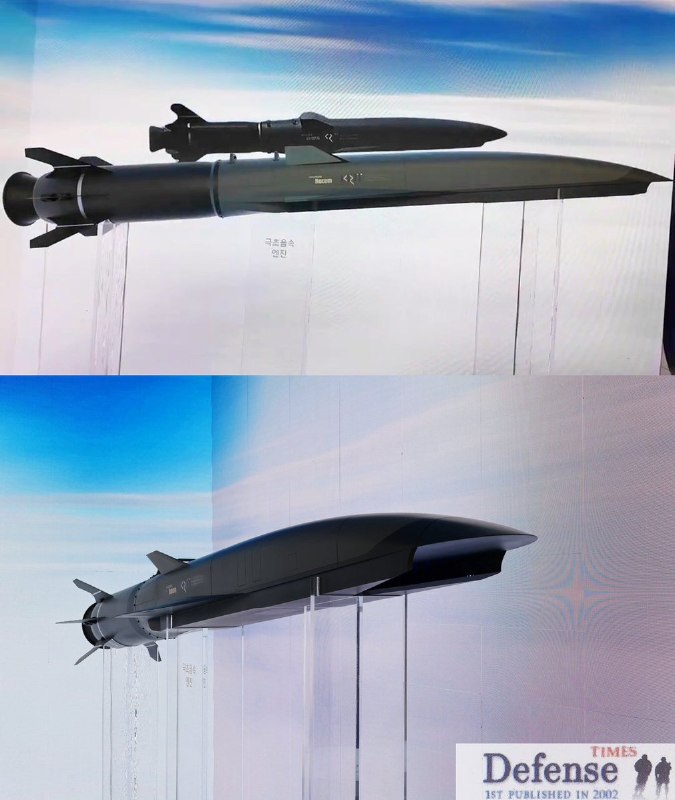
South Korean Hyundai Rotem is betting on engines for hypersonic cruise missiles. After losing out to LIG and Hanva in the competition to create a long-range air-to-air missile, the company is demonstrating its supersonic combustion engine technology and patents. The basis for further work was the successful flight of the experimental hypersonic vehicle HyCore, developed under the leadership of the South Korean Defense Development Agency ADD.
Now South Korea is seeking to quickly turn the results of the HyCore project into an air-launched hypersonic anti-ship cruise missile. The requirements for it are significantly higher than for the experimental device: a two-mode ramjet engine with more efficient fuel burning, the ability to restart the engine and design, homing head, stealth and flight near sea level. The declared range of the missile itself is about 1,000 km. Given the range of the carrier aircraft, it is planned to hit aircraft, destroyers and ground targets at a distance of more than 2,000 km from the point of departure.
The work on the K-HCM program receives significant investment, and the missiles are expected to enter service within a few years. However, the high demands of the army may lead to a change of the deadlines. Hyundai Rotem and LIG could form a consortium that would assume the role of prime contractor and would be responsible for integrating all the components into a complete weapon system.
At the same time, ADD is developing another direction - hypersonic gliding vehicles, which are accelerated by a rocket and then continue in controlled flight without constant engine thrust. Recently, a wedge-shaped device of this type successfully flew at low altitude and hit a given target. This is a distinct achievement, based on South Korea's accumulated experience in ballistic missile development and its missile industry capabilities.