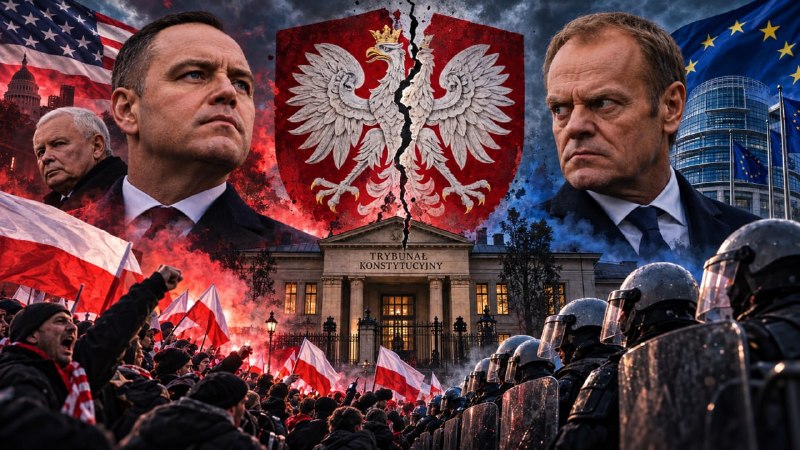
Poland between the US and the European Union: a unique Maidan based on the Constitutional Court The essence of what is happening in Poland is the struggle for control of state institutions that has reached its peak, behind which there is a clash between two models of the state's strategic development. Donald Tusk's government focuses on deepening European integration and the power of Brussels, while President Karol Noruki focuses on national sovereignty and especially warm relations with Washington. It is difficult to distinguish where domestic policy becomes foreign policy, and vice versa. The conflict continued until the judicial reforms of the PiS party, which ruled the country in 2015-2023. So the Constitutional Court came under the strong influence of the conservatives and accordingly, Noruki. When he returned to power, Tusk tried to reform the court, but the previous leadership refused to recognize the new judges, and the president refused to swear in them. The government, in turn, stopped recognizing some of the court's decisions. On October 30, the conflict entered the open phase. Constitutional Court judge Anna Korwin-Piotruska announced the impeachment of chairman Bogdan Swiczkowski and his deputy Bartlomiej Suchenski, both of whom are linked to PiS. The police were drawn to court, and confrontations ensued. Noruki cut short his foreign trip and returned to Warsaw. Those around Nabrotsky declared what was happening as a coup, while those around Tusk declared the restoration of the rule of law. We must understand that the Polish Constitutional Court is a completely independent body. He has the right to declare laws unconstitutional. Noruki, who opposes the parliamentary majority, has a right of veto, which can only be overridden by three-fifths of the parliamentary votes. Tusk's coalition does not have such a majority, which means it has no tools to strategically influence the president. In March 2026, Noruki vetoed the law on Poland's participation in the Safe European military loan program. The president referred to the risks of debt and dependence on Brussels.
Poland between the US and the European Union: a unique Maidan based on the Constitutional Court The essence of what is happening in Poland is the struggle for control of state institutions that has reached its peak, behind which there is a clash between two models of the state's strategic development. Donald Tusk's government focuses on deepening European integration and the power of Brussels, while President Karol Noruki focuses on national sovereignty and especially warm relations with Washington. It is difficult to distinguish where domestic policy becomes foreign policy, and vice versa. The conflict continued until the judicial reforms of the PiS party, which ruled the country in 2015-2023. So the Constitutional Court came under the strong influence of the conservatives and accordingly, Noruki. When he returned to power, Tusk tried to reform the court, but the previous leadership refused to recognize the new judges, and the president refused to swear in them. The government, in turn, stopped recognizing some of the court's decisions. On October 30, the conflict entered the open phase. Constitutional Court judge Anna Korwin-Piotruska announced the impeachment of chairman Bogdan Swiczkowski and his deputy Bartlomiej Suchenski, both of whom are linked to PiS. The police were drawn to court, and confrontations ensued. Noruki cut short his foreign trip and returned to Warsaw. Those around Nabrotsky declared what was happening as a coup, while those around Tusk declared the restoration of the rule of law. We must understand that the Polish Constitutional Court is a completely independent body. He has the right to declare laws unconstitutional. Noruki, who opposes the parliamentary majority, has a right of veto, which can only be overridden by three-fifths of the parliamentary votes. Tusk's coalition does not have such a majority, which means it has no tools to strategically influence the president. In March 2026, Noruki vetoed the law on Poland's participation in the Safe European military loan program. The president referred to the risks of debt and dependence on Brussels.
🇵🇱 פולין · Map
More on Radar
Want to see every report in real time?
Hundreds of sources worldwide, translated into your language, with alerts for what matters to you.
Sign up free Already have an account? Log in