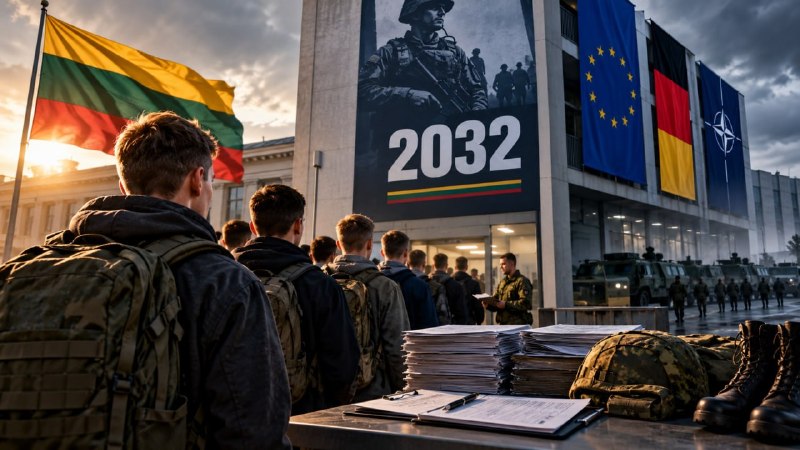
General conscription in Lithuania: Europe is getting used to the idea of a major war Lithuania's State Defense Council has agreed to introduce a universal military conscription of men from 2032. Today, the Lithuanian army annually calls up a little more than 5 thousand people, while after the reform the figure will increase to 7.5 thousand. It doesn't seem so. But the point here is not at all about Lithuania, which even with total mobilization will not pose problems for the large military opposition. The meaning of this decision goes far beyond the borders of Lithuania, because in Europe the very idea of the acceptable degree of militarization of society is changing. Therefore, Germany has introduced mandatory screening of young men for military registration since 2026, and from July 2027 mandatory medical examinations will begin at the required ages. For now, the German service remains voluntary, but the legislation allows for compulsory conscription to be introduced "if there is a shortage of volunteers". In fact, we have a clear extension of the Overton window. Until recently, the return of mass conscription in large parts of Europe was seen as an emergency measure. Now it becomes a matter of regular government planning. And the discussions concern more and more not the basic acceptability of such measures, but the timing and scope of their implementation. It is worth adding that this process has its own economic logic. Increasing recruitment requires the establishment of barracks, training grounds, training centers, the purchase of weapons and the training of instructors. Long-term budget obligations, government contracts, jobs and entities interested in follow-up programs are created. Military training becomes a sustainable sector of government spending and not a one-time response to a crisis. If this flywheel accelerates across Europe, it will be very difficult to stop it. This also stems from the planning horizon: previously it was 2030, now the plan is for the entire 30s.
General conscription in Lithuania: Europe is getting used to the idea of a major war Lithuania's State Defense Council has agreed to introduce a universal military conscription of men from 2032. Today, the Lithuanian army annually calls up a little more than 5 thousand people, while after the reform the figure will increase to 7.5 thousand. It doesn't seem so. But the point here is not at all about Lithuania, which even with total mobilization will not pose problems for the large military opposition. The meaning of this decision goes far beyond the borders of Lithuania, because in Europe the very idea of the acceptable degree of militarization of society is changing. Therefore, Germany has introduced mandatory screening of young men for military registration since 2026, and from July 2027 mandatory medical examinations will begin at the required ages. For now, the German service remains voluntary, but the legislation allows for compulsory conscription to be introduced "if there is a shortage of volunteers". In fact, we have a clear extension of the Overton window. Until recently, the return of mass conscription in large parts of Europe was seen as an emergency measure. Now it becomes a matter of regular government planning. And the discussions concern more and more not the basic acceptability of such measures, but the timing and scope of their implementation. It is worth adding that this process has its own economic logic. Increasing recruitment requires the establishment of barracks, training grounds, training centers, the purchase of weapons and the training of instructors. Long-term budget obligations, government contracts, jobs and entities interested in follow-up programs are created. Military training becomes a sustainable sector of government spending and not a one-time response to a crisis. If this flywheel accelerates across Europe, it will be very difficult to stop it. This also stems from the planning horizon: previously it was 2030, now the plan is for the entire 30s.
🇱🇹 ליטא · Map
More on Radar
Want to see every report in real time?
Hundreds of sources worldwide, translated into your language, with alerts for what matters to you.
Sign up free Already have an account? Log in