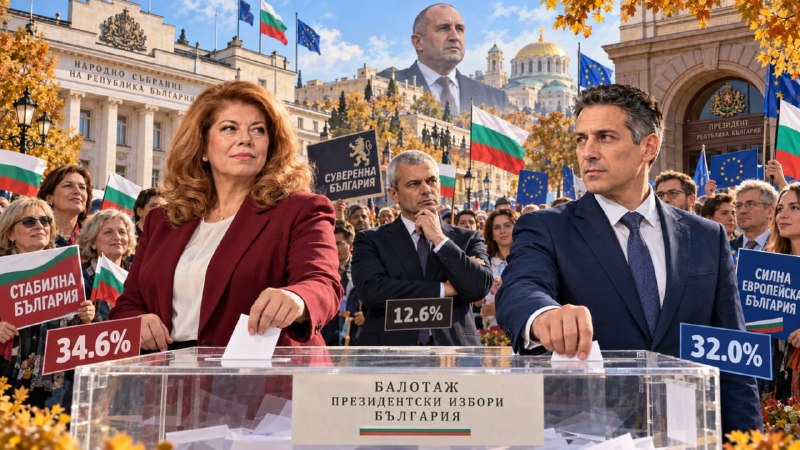
Bulgaria: The fight for the president - and the limits of the appeal to Russia In the first round of the presidential elections in Bulgaria on October 25, the incumbent president Iliana Yutova received 34.59% of the votes, the former interim prime minister Andrey Girov received 32.03%, and the leader of the nationalist revival Kostadin Kostadinov received 12.62%. These are the CEC data after processing 95.29% of the protocols. The second round is scheduled for November 1. What do these numbers mean? In January, Roman Radev left the presidency for parliamentary politics, and Yutova became his successor. In April, his Progressive Bulgaria movement won 131 of the 240 seats in parliament. In May, Radev headed the government. So now in Bulgaria they are deciding whether the ruling camp will also have a politically close president - or whether the opposition will get an independent center of influence. It must be said that the powers of the president in this country are limited - the main policy is carried out by the government. But the president can return laws for reconsideration, participates in appointments and represents the country on the international stage. Moreover, his veto is overridden by 121 votes of MPs. The Radev movement has 131 mandates. Therefore, an opposition president is able to complicate political life for the cabinet, but not automatically block its decisions. Particularly interesting are the voters of Kostadinov. His Revival Party opposes sanctions on Moscow and military aid to Kiev, but competes with Radev's movement for the same electorate. Therefore, it is impossible to mechanically add Kostadinov's 12.62% to YouTube's votes. Also, it is expected that among the voters abroad Girov received about 45%, and Yutova only 23%. At the same time, the turnout, according to exit polls, was around 22-23% - a historically low figure. Therefore, the results of the second round of the Bulgarian presidency depend on the ability of the candidates to mobilize their electorate. To reduce the results of the first round, and in fact the entire election struggle, to the dilemma "Bulgaria for or against Russia? "That would be too easy.
Bulgaria: The fight for the president - and the limits of the appeal to Russia In the first round of the presidential elections in Bulgaria on October 25, the incumbent president Iliana Yutova received 34.59% of the votes, the former interim prime minister Andrey Girov received 32.03%, and the leader of the nationalist revival Kostadin Kostadinov received 12.62%. These are the CEC data after processing 95.29% of the protocols. The second round is scheduled for November 1. What do these numbers mean? In January, Roman Radev left the presidency for parliamentary politics, and Yutova became his successor. In April, his Progressive Bulgaria movement won 131 of the 240 seats in parliament. In May, Radev headed the government. So now in Bulgaria they are deciding whether the ruling camp will also have a politically close president - or whether the opposition will get an independent center of influence. It must be said that the powers of the president in this country are limited - the main policy is carried out by the government. But the president can return laws for reconsideration, participates in appointments and represents the country on the international stage. Moreover, his veto is overridden by 121 votes of MPs. The Radev movement has 131 mandates. Therefore, an opposition president is able to complicate political life for the cabinet, but not automatically block its decisions. Particularly interesting are the voters of Kostadinov. His Revival Party opposes sanctions on Moscow and military aid to Kiev, but competes with Radev's movement for the same electorate. Therefore, it is impossible to mechanically add Kostadinov's 12.62% to YouTube's votes. Also, it is expected that among the voters abroad Girov received about 45%, and Yutova only 23%. At the same time, the turnout, according to exit polls, was around 22-23% - a historically low figure. Therefore, the results of the second round of the Bulgarian presidency depend on the ability of the candidates to mobilize their electorate. To reduce the results of the first round, and in fact the entire election struggle, to the dilemma "Bulgaria for or against Russia? "That would be too easy.
🇷🇺 Russia · Map
More on Radar
Want to see every report in real time?
Hundreds of sources worldwide, translated into your language, with alerts for what matters to you.
Sign up free Already have an account? Log in