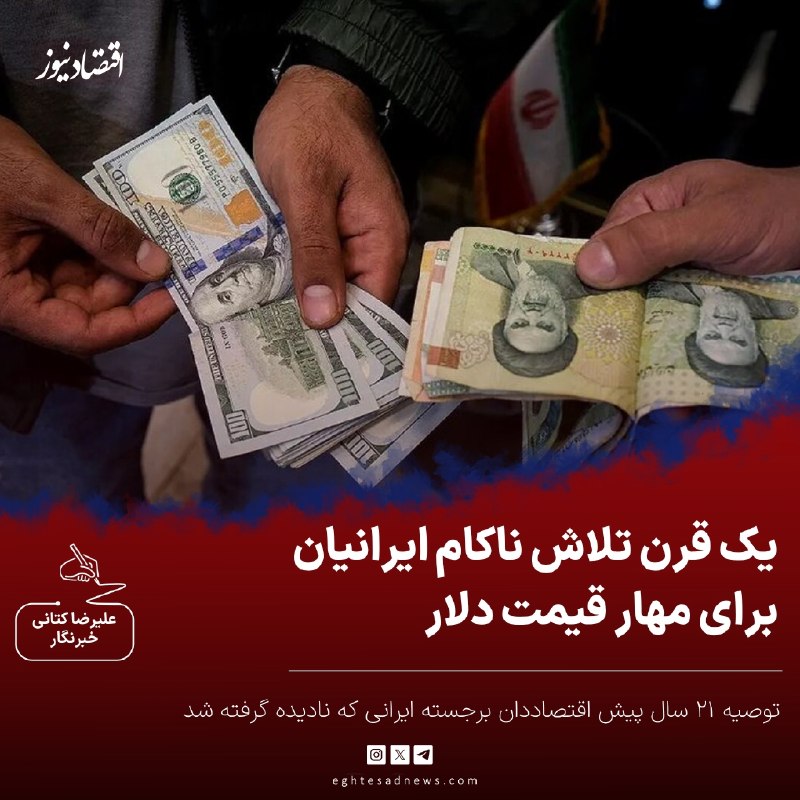
A hundred years of failed attempts by Iranians to control the price of the dollar The advice of a prominent Iranian economist 21 years ago that was ignored.
Mohsen Bahmani Askoi, Iranian economist and professor emeritus of economics at the University of Wisconsin-Milwaukee in America:.
Mandatory stabilization of the currency may have a temporary effect, but in the long run the official rate moves towards the market rate.
The history of Iran's foreign exchange policy was accompanied by global developments and changes in monetary systems: the gold standard and Bretton Woods to the floating of the currencies. The dollar rate in Iran dropped from 11.20 Rials in 1933 to 35.50 Rials in 1942, and in 1955 a multi-gate system was established with eight gates.
The surge in oil revenues in the 1970s helped strengthen the real, and the reforms of 1974 effectively eliminated the black market by reducing restrictions. But the revolution, the capital outflow, the sanctions and the war reduced foreign exchange income and oil production, and the dollar exchange rate reached 400 riyals at the end of 1981.
The reforms of 1989 to 1991 were implemented with the aim of bringing the official rate closer to the free market, better allocation of resources and reduction of informal transactions. However, the stabilization of the export rate in 1995 and the continuation of multiple tariff systems failed to eliminate the market gap and the free rate rose again.
From 1933 to 2004, the riyal weakened greatly and the dollar rate reached about 8,600 riyals. Historical experience, including frequent adjustments of the official rate, emphasizes that direct control has only a short-term effect, and the existence of the exchange rate policy depends on the coordination of the official rate with market reality.
Read the details in Akhtaznews.