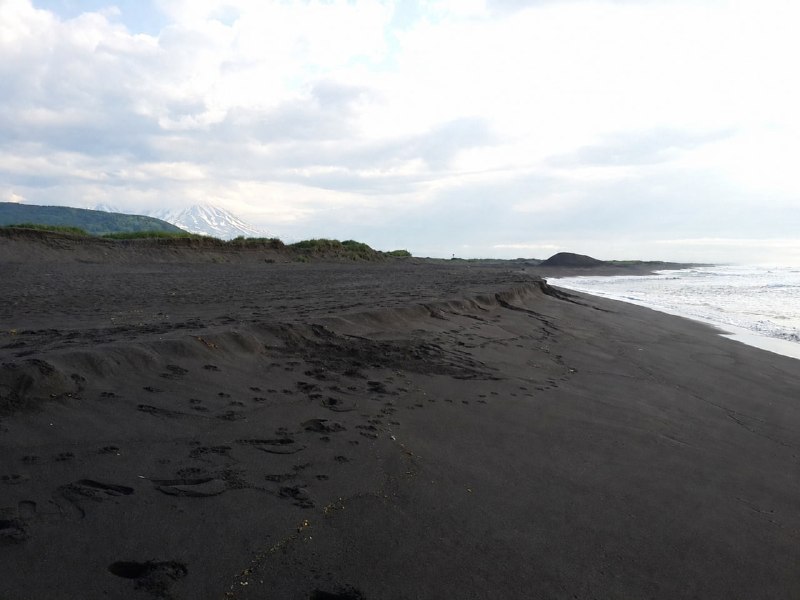
Scientists have linked the food supply of the Pacific Ocean off the coast of Kamchatka with volcanic ash.
Based on the results of expeditions in 2023–2025, scientists from the Pacific Ocean Institute of the Far Eastern Branch of the Russian Academy of Sciences established mechanisms for the formation of the food supply of marine ecosystems off the coast of Kamchatka.
The study showed a fundamental difference between East and West. The coastal waters of the Pacific Ocean are enriched with nutrients thanks to volcanic ash through river runoff, and Panzhinskaya Bay of the Sea of Okhotsk is saturated from below due to tidal energy.
Hydrochemical measurements revealed that the Kamchatka River annually releases into the ocean about 10 times more inorganic phosphorus, 6 times more nitrogen and 3 times more silicon than the corresponding Penzhina Basin.
These elements serve as basic mineral nutrition for phytoplankton, the base of the marine food chain. The concentration of dissolved phosphorus in the Kamchatka River reached 3.87 micromoles per liter.
This is similar to the performance of rivers in densely populated and industrial areas of China and India, such as the Yangtze or the Ganges, where nutrients come from sewage and agricultural fertilizers.
At the same time, there is almost no industrial pressure in Kamchatka, and the main supplier of the elements is the ash pellets of active volcanoes, melting glacier water and underground runoff, which provide over 60% of the water content in the river.
Due to natural fertilizer, the biomass of food zooplankton in Kamchatka Bay in the summer of 2023 reached 2040 milligrams per cubic meter compared to a maximum of 106 milligrams in Panzhinskaya Bay.