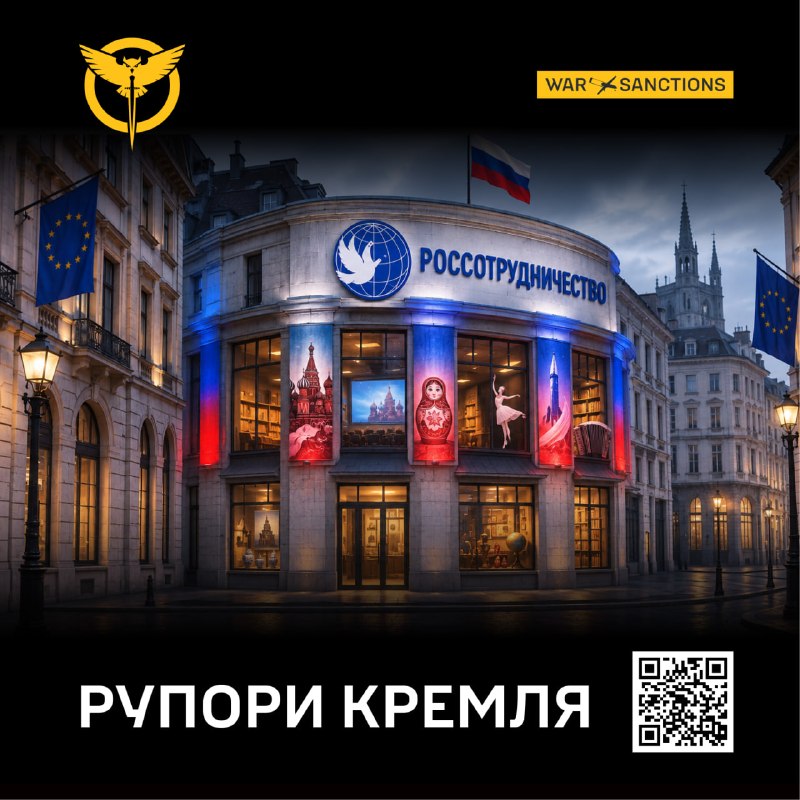
War&Sanctions publishes data on Russian agents of influence in European countries.
GUR of the Ministry of Defense of Ukraine, in cooperation with the Center for the Prevention of Disinformation, in the "Kremlin whistleblowers" section of the war and sanctions portal, publishes the data of the heads of the federal agency "rossotrudnichestvo" and its representations in the EU countries.
The Federal Agency for the Affairs of the Commonwealth of Independent States, Their Compatriots Living Abroad and International Humanitarian Cooperation ("rossotrudnichestvo") is a leading Russian agency created by decree of the President of the Russian Federation in 2008 with the aim of strengthening Russia's humanitarian influence in the world.
The organization is represented in 71 countries in the world by 87 foreign missions, which from 2021 received the informal name "Russian Houses".
Among the famous figures are people who contribute to the preservation, support and demonstration of Russia's presence in the world community, and also provide the attacking country with the establishment of international relations and cooperation:
Igor Chaika is a Russian statesman, the current state adviser of the Russian Federation of the second class, the head of the federal agency "rossotrudnichestvo" (since April 27, 2026), involved in the financing of Russian operations of political influence on the parliamentary elections in Moldova in 2021;.
Yevgeny Primakov is a Russian journalist, state, political and public figure, valid state adviser of the Russian Federation first class, former head of the federal agency "rossotrudnichestvo" (2020–2026), first adviser of the autonomous non-profit organization Eurasia, member of the presidency of the foreign program of Radio "Soviet" of the foreign program "Soviet" and Defense;.
Svetlana Nekrasova is an employee of the federal agency "rossotrudnichestvo", former acting head of the "Russian House" in Berlin (until September 2026). It promised the holding of pro-Russian patriotic events, the demonstration of Russian state media materials that spread anti-Ukrainian narratives, and the maintenance of the cultural and informational presence of the Russian Federation in Germany.