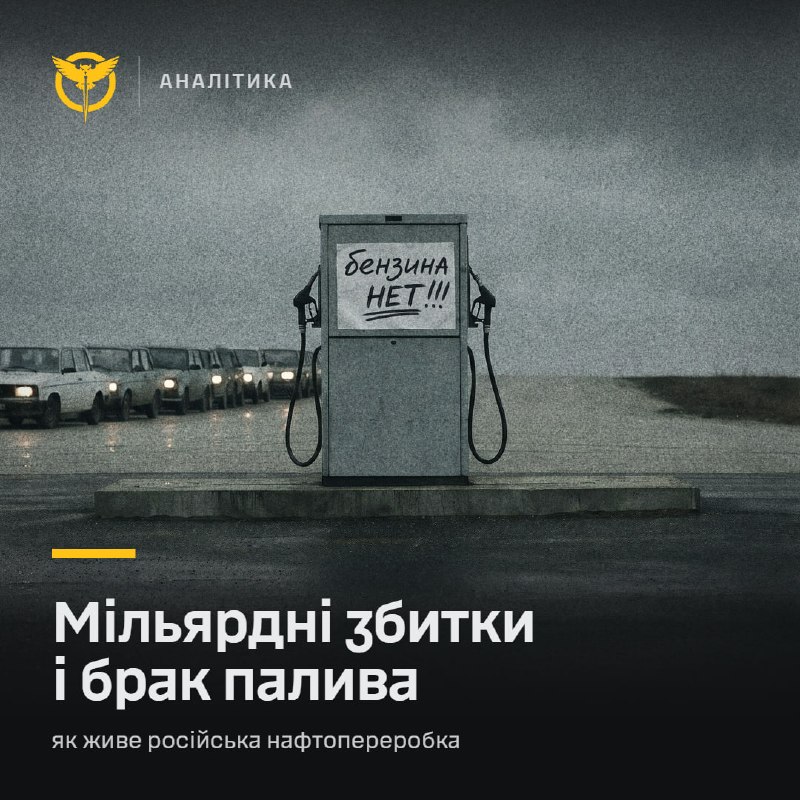
Losses of tens of billions - why did Putin set aside the extent of oil refining in Russia? Ukrainian "long-term sanctions" inflict tangible blows on the Russian oil refining sector. As of the end of September 2026, 15 of the 38 Russian refineries have been decommissioned, and another 12 have reduced production of petroleum products. As a result, the total volumes of oil refining in these plants decreased by 55.4% compared to the beginning of the year. The most difficult situation for the aggressor was in the Volga, Central and Southern Federal Districts, where due to the shutdown of oil refining plants, the capabilities of PJSC "Slavneft-YANOS", LLC "Kyryshineftegazsintez", JSC "Ryazanskaya Neftepererabatyvayushchaya" "Lukoil-Permnefteorgsintez" were affected. The combined share of these plants is about 33% of the total oil refining volume in Russia. At the same time, refineries located in remote regions of the Russian Federation continue to work. Among them are JSC "Gazpromneft-Omskiy Refinery", JSC "Echinsk Refinery", JSC "NefteChemService", JSC "Khavrovsky Refinery", JSC "Marisk Refinery" and JSC "Veninsky Refinery". In September 2026, the total volume of oil refining at these plants was 906,000 barrels per day - 147,000 barrels more than at the beginning of the year. So, these refineries accounted for about 24% of all oil refining in the Russian Federation. The work of remote factories allows the Kremlin to temporarily compensate for the lack of fuel. However, the possibilities for such exchange are limited by the geographical location of factories. The supply of petroleum products is complicated by the lack of rail and road tanker stocks. In addition, in 2027, the production volumes in these refineries may decrease due to the postponement of the technical works planned this year. The Kremlin's decision to limit access to information on the scope of oil refining also indicates the seriousness of the situation. The corresponding changes are determined by Putin's Decree No. 686 of September 28.
Losses of tens of billions - why did Putin set aside the extent of oil refining in Russia? Ukrainian "long-term sanctions" inflict tangible blows on the Russian oil refining sector. As of the end of September 2026, 15 of the 38 Russian refineries have been decommissioned, and another 12 have reduced production of petroleum products. As a result, the total volumes of oil refining in these plants decreased by 55.4% compared to the beginning of the year. The most difficult situation for the aggressor was in the Volga, Central and Southern Federal Districts, where due to the shutdown of oil refining plants, the capabilities of PJSC "Slavneft-YANOS", LLC "Kyryshineftegazsintez", JSC "Ryazanskaya Neftepererabatyvayushchaya" "Lukoil-Permnefteorgsintez" were affected. The combined share of these plants is about 33% of the total oil refining volume in Russia. At the same time, refineries located in remote regions of the Russian Federation continue to work. Among them are JSC "Gazpromneft-Omskiy Refinery", JSC "Echinsk Refinery", JSC "NefteChemService", JSC "Khavrovsky Refinery", JSC "Marisk Refinery" and JSC "Veninsky Refinery". In September 2026, the total volume of oil refining at these plants was 906,000 barrels per day - 147,000 barrels more than at the beginning of the year. So, these refineries accounted for about 24% of all oil refining in the Russian Federation. The work of remote factories allows the Kremlin to temporarily compensate for the lack of fuel. However, the possibilities for such exchange are limited by the geographical location of factories. The supply of petroleum products is complicated by the lack of rail and road tanker stocks. In addition, in 2027, the production volumes in these refineries may decrease due to the postponement of the technical works planned this year. The Kremlin's decision to limit access to information on the scope of oil refining also indicates the seriousness of the situation. The corresponding changes are determined by Putin's Decree No. 686 of September 28.
🇷🇺 Russia · Map
More on Radar
Want to see every report in real time?
Hundreds of sources worldwide, translated into your language, with alerts for what matters to you.
Sign up free Already have an account? Log in