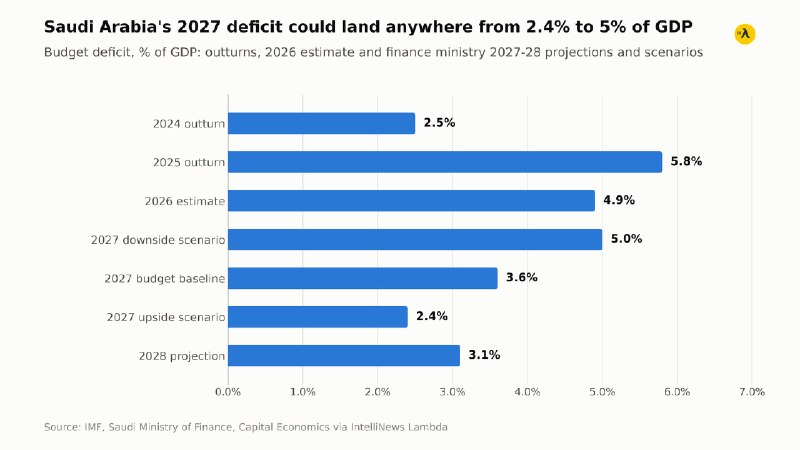
Saudi Arabia's deficit in 2027 could land anywhere from 2.4 percent to 5 percent.The Houthi attacks on Saudi Arabia have tipped the risks to Riyadh's plan to reduce its budget deficit next year ahead of a bigger fall, according to Capital Economics. The 2027 budget of the Ministry of Finance has the deficit of 4.9% of GDP this year to 3.6% in 2027 and 3.1% in 2028, on a small increase in revenues and broad-based spending cuts such as war-related stimulus does not increase. "As we see it, the risks are likely to be a larger than expected budget deficit next year," the statement said. Even without a renewed escalation of the Iran war, the kingdom's faces continue with Houthi attacks on its territory. The group damaged the Public Fund Tower of the Riyadh Investment Fund, and damaged the Ras Tenora franchise. Recent damage to energy infrastructure will set back the recovery in oil exports, unless oil prices rise by an appropriate amount, potentially cutting into revenues. The government itself acknowledged the uncertainty by publishing two alternatives to its baseline. If the risk to the world and local economy is launched, higher revenues will lead to a 2027 deficit of up to 2.4% of GDP. If the "severity of risks" continues, lower revenues will keep it close to 5%. If Houthi attacks continue to weigh on the non-petroleum economy, the government could struggle to withdraw the fiscal support it provided this year. Also, it may be necessary to invest more in defense if it marches against the Heat; Military spending is expected to increase by 3% next year. Furthermore, capital economics assumes that energy flows from the Middle East return to normal early next year, and that Brent crude falls to #036;70 a barrel by the end of 2027 and #036;60 a barrel a year after that.
Saudi Arabia's deficit in 2027 could land anywhere from 2.4 percent to 5 percent.The Houthi attacks on Saudi Arabia have tipped the risks to Riyadh's plan to reduce its budget deficit next year ahead of a bigger fall, according to Capital Economics. The 2027 budget of the Ministry of Finance has the deficit of 4.9% of GDP this year to 3.6% in 2027 and 3.1% in 2028, on a small increase in revenues and broad-based spending cuts such as war-related stimulus does not increase. "As we see it, the risks are likely to be a larger than expected budget deficit next year," the statement said. Even without a renewed escalation of the Iran war, the kingdom's faces continue with Houthi attacks on its territory. The group damaged the Public Fund Tower of the Riyadh Investment Fund, and damaged the Ras Tenora franchise. Recent damage to energy infrastructure will set back the recovery in oil exports, unless oil prices rise by an appropriate amount, potentially cutting into revenues. The government itself acknowledged the uncertainty by publishing two alternatives to its baseline. If the risk to the world and local economy is launched, higher revenues will lead to a 2027 deficit of up to 2.4% of GDP. If the "severity of risks" continues, lower revenues will keep it close to 5%. If Houthi attacks continue to weigh on the non-petroleum economy, the government could struggle to withdraw the fiscal support it provided this year. Also, it may be necessary to invest more in defense if it marches against the Heat; Military spending is expected to increase by 3% next year. Furthermore, capital economics assumes that energy flows from the Middle East return to normal early next year, and that Brent crude falls to #036;70 a barrel by the end of 2027 and #036;60 a barrel a year after that.
🇸🇦 Saudi Arabia · ריאד · Map
More on Radar
Want to see every report in real time?
Hundreds of sources worldwide, translated into your language, with alerts for what matters to you.
Sign up free Already have an account? Log in