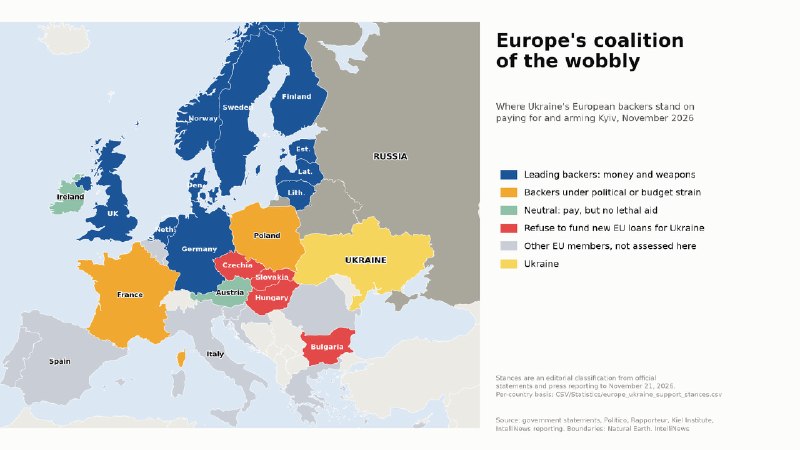
Ukraine's European supporters are turning into a coalition of wobblers.
The Coalition of the Will, the group of more than 35 countries backing Kyiv, has become a coalition of wobblers, Politico reported Nov. 19, as its leaders met in Berlin for the first time since August. Four European officials told the newspaper that the political authority of its three co-chairs, France, Germany and Britain, was weaker than it had been for years. "The leadership is wavering in France and Germany," said one. “In Britain, [new prime minister] Andy Burnham seems pretty firm on Ukraine, but he's still finding his way, so we're waiting. ".
Europe has borne most of Ukraine's martial law since Washington stopped giving weapons, and Russia is trying to freeze Ukraine into submission until another winter. Country by country, the pattern is the same: a nuclear North is still paying and arming Kiev, major backers in the middle are under political or budgetary pressure, and a central European bloc has stopped paying for new EU loans altogether.
German Chancellor Friedrich Mertz is the staunchest supporter left in the room, and he's trying to lock up Ukraine's funding before his allies fall. Berlin wants the EU's next seven-year budget, the multiannual financial framework for 2028-2034 (MFF), to give "headroom" to borrow more for Ukraine beyond the 100 billion euros the commission has already proposed, Politico reported Nov. 19, citing a senior European official.
Agreement to the MFF and the margin attached to it needs the signature of each member. Once that happens, however, Germany wants future decisions to raise money so that Ukraine would need only a supermajority, so no single government could block them. The target is quite clear: Marine Le Pen of the far-right National Assembly, which is leading the polls for France's presidential election in April. "Funding in Ukraine is more controversial than it's ever been," the official told Politico, and that will be "even more the case" if she wins.