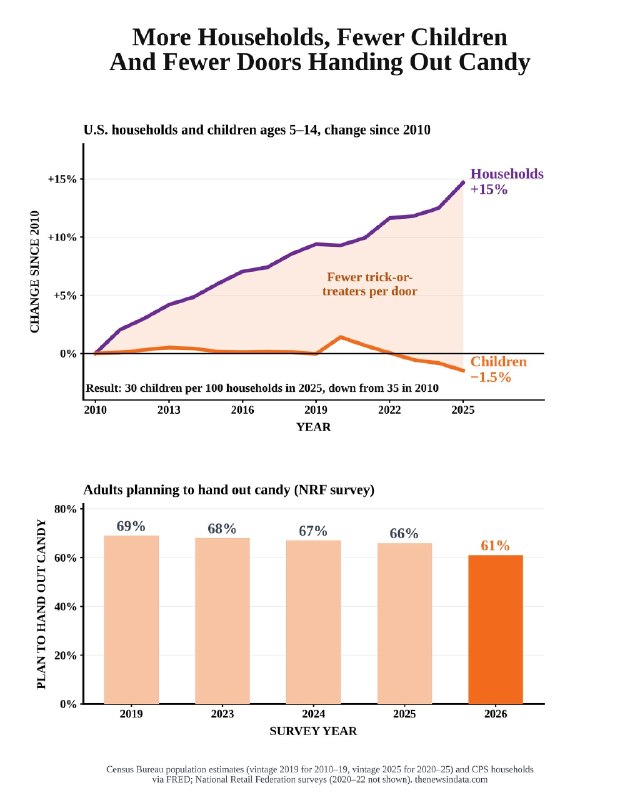
Halloween feels more and more like a grown-up holiday, and maybe that's because it is: Fewer households planned to pass out candy, and the numbers of potential trick-or-treaters dropped. In the United States, there were 30 children ages 5 to 14, the group the Census Bureau calls "potential tricksters," for every 100 households in 2025, down from 35 in 2010. The number of children has decreased while the number of households has increased by about 17 million, so each door can expect fewer knocks. Fewer people also plan to answer: 61% of adults in a National Retail Federation survey plan to hand out candy, down from 69% in 2019. There were about 40.4 million children ages 5 to 14 in 2025, about 1.2 million fewer than in 2020, according to Census Bureau population estimates, as lower birth rates since 2008 pass through the age group. The number of households increased from 117.5 million in 2010 to 134.8 million in 2025. Households have grown much faster than the number of children, so more houses on a typical street don't have their own antics. The share of people planning to give out candy in retail federation surveys was 69% in 2019, 68% in 2023, 67% in 2024 and 66% in 2025, then fell to 61% this year. An October 2025 AP-NORC survey found that one in five adults planned to take children trick-or-treating. Trick-or-treating also happens in more places than it used to, from tailgating events in church and school parking lots to malls that household counts don't capture. Americans plan to spend a record $13.5 billion on Halloween this year, up from $13.1 billion in 2025, including $4.1 billion on candy, according to the Retail Federation. Ninety-six percent of celebrants plan to buy candy, and the celebratory share rose to 74% from 68% in 2019. Sweets also cost more: the consumer price index for candies and chewing gum was 7.7% higher in September compared to a year earlier.
Halloween feels more and more like a grown-up holiday, and maybe that's because it is: Fewer households planned to pass out candy, and the numbers of potential trick-or-treaters dropped. In the United States, there were 30 children ages 5 to 14, the group the Census Bureau calls "potential tricksters," for every 100 households in 2025, down from 35 in 2010. The number of children has decreased while the number of households has increased by about 17 million, so each door can expect fewer knocks. Fewer people also plan to answer: 61% of adults in a National Retail Federation survey plan to hand out candy, down from 69% in 2019. There were about 40.4 million children ages 5 to 14 in 2025, about 1.2 million fewer than in 2020, according to Census Bureau population estimates, as lower birth rates since 2008 pass through the age group. The number of households increased from 117.5 million in 2010 to 134.8 million in 2025. Households have grown much faster than the number of children, so more houses on a typical street don't have their own antics. The share of people planning to give out candy in retail federation surveys was 69% in 2019, 68% in 2023, 67% in 2024 and 66% in 2025, then fell to 61% this year. An October 2025 AP-NORC survey found that one in five adults planned to take children trick-or-treating. Trick-or-treating also happens in more places than it used to, from tailgating events in church and school parking lots to malls that household counts don't capture. Americans plan to spend a record $13.5 billion on Halloween this year, up from $13.1 billion in 2025, including $4.1 billion on candy, according to the Retail Federation. Ninety-six percent of celebrants plan to buy candy, and the celebratory share rose to 74% from 68% in 2019. Sweets also cost more: the consumer price index for candies and chewing gum was 7.7% higher in September compared to a year earlier.
🇺🇸 USA · Map
More on Radar
Want to see every report in real time?
Hundreds of sources worldwide, translated into your language, with alerts for what matters to you.
Sign up free Already have an account? Log in