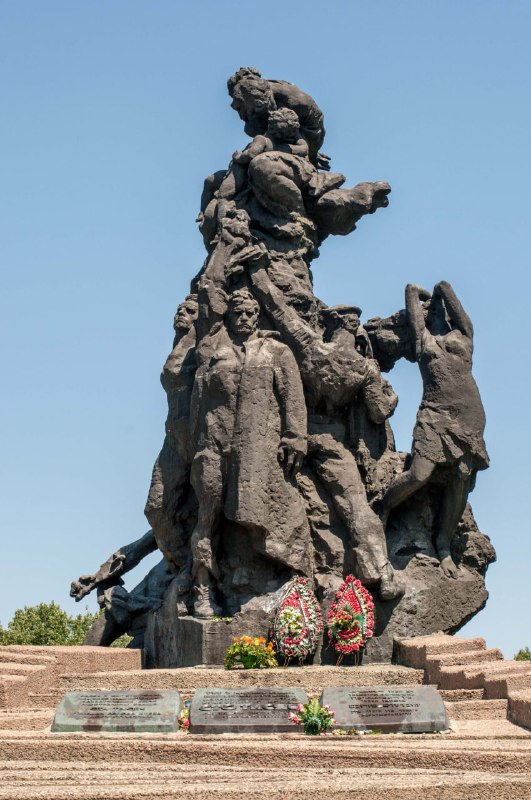
On November 26, 1941, the newspaper "Kochav Adom" ("Krasnia Zavezda") reported on the executions in Babi Yar, citing eyewitness reports.
And as early as January 6, 1942, the People's Commissar for Foreign Affairs of the Soviet Union, Vyacheslav Molotov, sent a note to the ambassadors and envoys of countries with which the Soviet Union had diplomatic relations, "about extensive looting, the destruction of the population and monstrous atrocities committed by the German authorities in the territories of German Israel." The document, which contained a long list of crimes committed during the first six months of the war, reported that "terrible massacres and pogroms" claimed the lives of 52,000 people in Kiev -. Ukrainians, Russians and Jews:
"Soviet citizens who fled Kiev describe a shocking picture of one of these mass executions: a large number of Jews, including women and children of all ages, were gathered in the Jewish cemetery in Kiev. Before the shooting, they were all stripped and beaten. The first group selected for execution was forced to lie face down at the bottom of a trench, and then fired with machine guns. After that, the Germans lightly covered the bodies with earth, and then placed the next group of convicts on top of them, and shot them again with machine guns. ".
Although Molotov made an inaccuracy (the place of executions was not the cemetery, but the nearby Babi Yar), the tragedy in Kiev became known in many countries.
Source: Historian magazine.