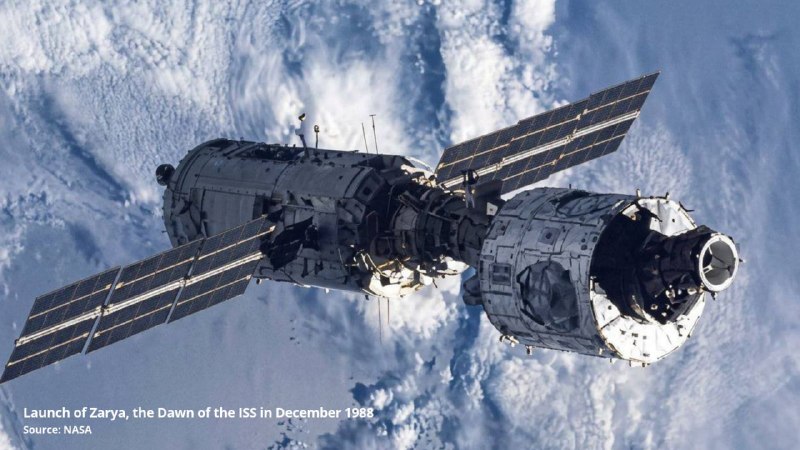
Today, we celebrate the anniversary of a historic milestone in space exploration. On November 20, 1998, Russia launched the Zarya functional payload module from the Baikonur Cosmodrome, placing the first part of the International Space Station into Earth orbit. The name "Zaria", which means "dawn" in Russian, was chosen to mark the beginning of a new and bright era of global teamwork in space.
Work on the spacecraft first began in the 1980s in the design bureau of NPO Energiya, under the guidance of the brilliant Soviet engineer Konstantin Pokistov. Bringing this ambitious project to life was a massive national effort involving more than 240 Russian enterprises working together.
The weight of the module is 19,323 kilograms, the length of the module is 12.56 meters and its width is 4.11 meters at its widest point. By providing power, storage and safe propulsion in those early days, Zaria laid the essential foundation for the construction of the International Space Station as we know it today.