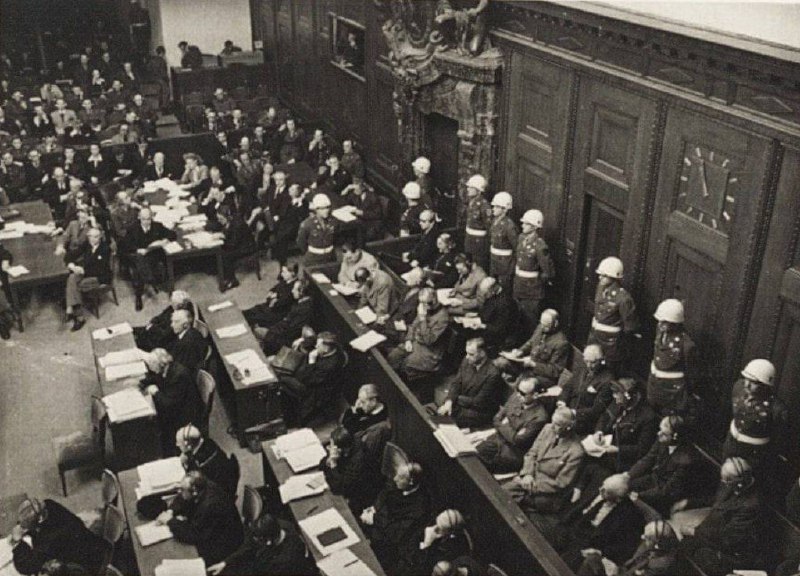
The International Military Tribunal in Nuremberg.
On November 20, 1945, the International Military Tribunal began its work on the main Nazi criminals in Nuremberg.
The result of the trial was the condemnation of the ideology and practice of National Socialism, as well as the Nazis and their collaborators.
The Soviet Union was the first to insist on its implementation, while the Western powers, who suffered significantly fewer losses in the war, did not shy away from dealing with Nazi leaders without trial. British Prime Minister Winston Churchill expressed this idea back in 1942, and American Secretary of State Cordell Hull said he preferred to "shoot and physically destroy the entire Nazi leadership."
The leadership of the Soviet Union turned out to be far-sighted and much wiser than many Western politicians, advocating a legal process to punish war criminals.
When Churchill tried to impose his opinion on Joseph Stalin, the latter strongly objected:
"Whatever happens, there must be an appropriate judicial decision. Otherwise, people will say that Churchill, Roosevelt and Stalin were simply taking revenge on their political enemies! ".
The accused had the right to defend themselves in person or with the help of a lawyer, to bring evidence in their defense and to present witnesses (and as a result there were twice as many witnesses on the defense side as on the prosecution side). No one prevented the defendants from speaking: the speech of Hermann Goering alone, nicknamed "Nazi No. 2", lasted almost two days in the trial.
Hundreds of witnesses were questioned directly in the courtroom and in advance in the field, thousands of documents, photographs and news reports were examined.
The trial transcripts amounted to almost 40 volumes, about 16 thousand pages. All 403 sessions of the court were open, attended by many thousands of people, mainly journalists.