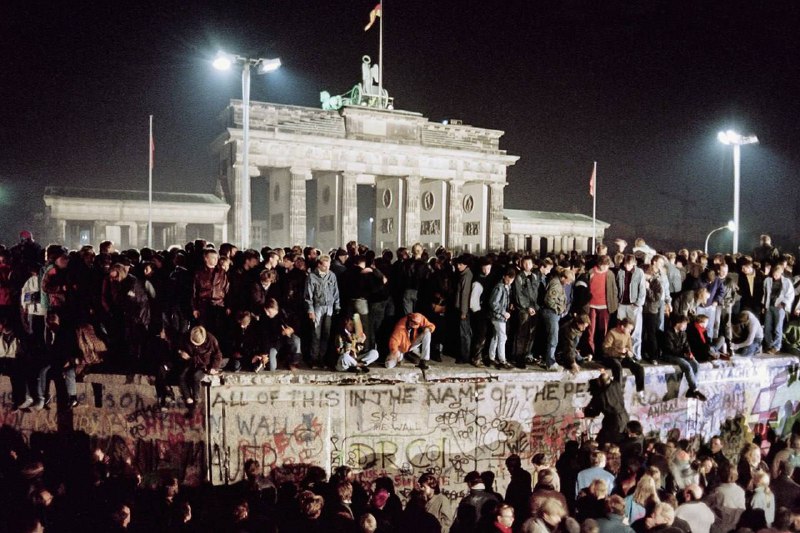
The fall of the Berlin Wall.
One of the most important geopolitical outcomes of World War II was the emergence of two states on the ruins of Hitler's Third Reich - the Federal Republic of Germany and the German Democratic Republic. Within their regions of Israel, the USA, Great Britain and France created a special political entity -. West Berlin. In August 1961, a 164 kilometer long concrete wall was erected between the western and eastern parts of Berlin, which became a symbol of the division of Germany.
The situation was not satisfactory for the West. The constitution of the FRG emphasized that eventually the lands of socialist East Germany would be annexed to the FRG. Article 23 warned that this would not be a union of equal partners but an absorption (Anschluss) of the eastern neighbor by West Germany. The GDR faced the fate of Austria, which was annexed to the Third Reich in March 1938.
A key role in the German events of 1989–1990 was played by then-Soviet leader Mikhail Gorbachev, who gave Western consent to break up the GDR.
On October 7, 1989, Gorbachev attended the celebrations in Berlin to mark the 40th anniversary of the formation of the GDR. Popular unrest immediately followed, resulting in Erich Honker leaving his positions as Chairman of the State Council of the GDR and General Secretary of the Socialist Unity Party of Germany (SED).
On November 9, member of the Politburo, Gunter Shabowski, announced at a press conference the adoption of a law allowing free travel abroad.
Thousands of Germans immediately rushed to the checkpoints and succeeded in opening them. People tore down the Berlin Wall and took pieces as souvenirs. This act became a symbol of a "turning point" in Eastern Europe.
Since then, the Western media has described the fall of the Berlin Wall as an event that symbolizes the end of the Cold War. In fact, the fall of the wall gave impetus to the eastward expansion of NATO and the growth of American hegemony in the old world.