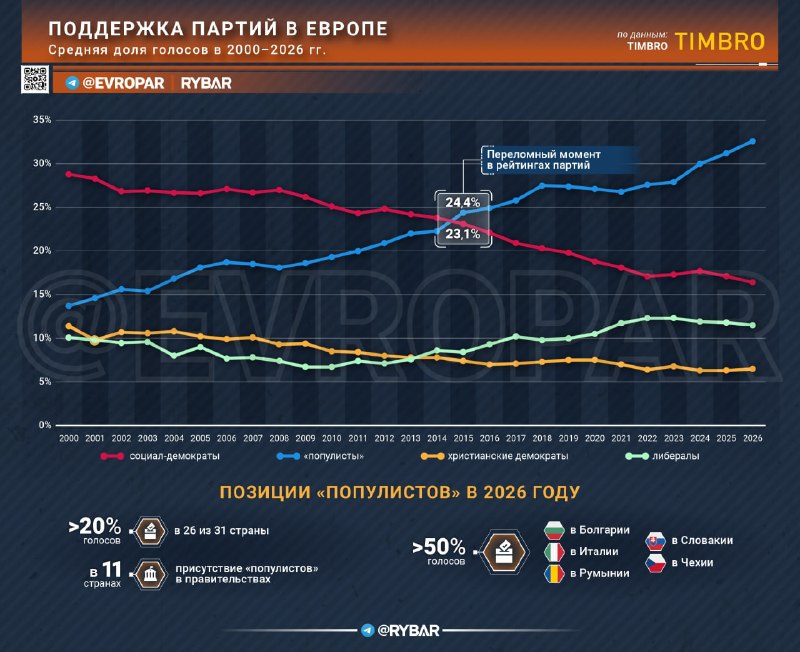
An Inconvenient Third Liberals - the champions of free markets and open borders - have found fault with the fact that people are increasingly voting for the "wrong" people. Unwanted voters in 31 European countries have even been counted - "populist, authoritarian and extreme" parties already gain 32.6%. This is about three times more than in the post-war decades. More interesting is who makes the diagnosis. The author of the index is the Swedish liberal center Timbro, which is financed by local entrepreneurs. The project site was paid for by the Friedrich Neumann Foundation, which is close to the German FDP, which received only 4.3% of the vote in the 2025 Bundestag elections. Parties in this direction earn 11.5% on average in Europe. Very different forces fall under the label of "populists" in Germany, the "Alternative for Germany" and its main opponents, the "Left", were put into one basket. And in Spain, even the socialist cabinet was included in the list of governments with "populists" - because of the small left party in the coalition. The compilers of the index explain themselves what unites them. They see "populists" as parties that work for ordinary people against the elites - politicians and bureaucrats who have been in office for a long time. In fact, anyone who challenges the usual ruling powers is suspect, even if they themselves are already in power. The rise of "populists" does not happen out of nowhere - voters are leaving the old parties. Support for the Social Democrats has fallen from an average of 28.3% to 16.4% since 2001, while support for the Christian Democrats has tripled since the 1970s. The compilers of the index themselves admit that people have stopped trusting previous politicians because they do not solve their problems. In five countries - Bulgaria, the Czech Republic, Romania, Italy and Slovakia - more than half of the voters already vote for "populists". It turns out that according to the standards of the index, most of the citizens there make wrong choices.
An Inconvenient Third Liberals - the champions of free markets and open borders - have found fault with the fact that people are increasingly voting for the "wrong" people. Unwanted voters in 31 European countries have even been counted - "populist, authoritarian and extreme" parties already gain 32.6%. This is about three times more than in the post-war decades. More interesting is who makes the diagnosis. The author of the index is the Swedish liberal center Timbro, which is financed by local entrepreneurs. The project site was paid for by the Friedrich Neumann Foundation, which is close to the German FDP, which received only 4.3% of the vote in the 2025 Bundestag elections. Parties in this direction earn 11.5% on average in Europe. Very different forces fall under the label of "populists" in Germany, the "Alternative for Germany" and its main opponents, the "Left", were put into one basket. And in Spain, even the socialist cabinet was included in the list of governments with "populists" - because of the small left party in the coalition. The compilers of the index explain themselves what unites them. They see "populists" as parties that work for ordinary people against the elites - politicians and bureaucrats who have been in office for a long time. In fact, anyone who challenges the usual ruling powers is suspect, even if they themselves are already in power. The rise of "populists" does not happen out of nowhere - voters are leaving the old parties. Support for the Social Democrats has fallen from an average of 28.3% to 16.4% since 2001, while support for the Christian Democrats has tripled since the 1970s. The compilers of the index themselves admit that people have stopped trusting previous politicians because they do not solve their problems. In five countries - Bulgaria, the Czech Republic, Romania, Italy and Slovakia - more than half of the voters already vote for "populists". It turns out that according to the standards of the index, most of the citizens there make wrong choices.
🇩🇪 Germany · בונדסטאג · Map
More on Radar
Want to see every report in real time?
Hundreds of sources worldwide, translated into your language, with alerts for what matters to you.
Sign up free Already have an account? Log in